Republicans Reduce Farm Program Benefits, Again

House Republicans have proposed to reduce farm program benefits in the farm bill section of their big brutal budget reconciliation bill. Democrats should raise up this issue politically, in order to take back the rural vote, where so many states have become more Republican in recent years.

The Failed Farm Policies of the Anti-Farmer Republicans

(To see what the House Republican Reconciliation Bill did, skip ahead to the heading “Proposed Republican Reductions for the Price Loss Coverage Program.”)

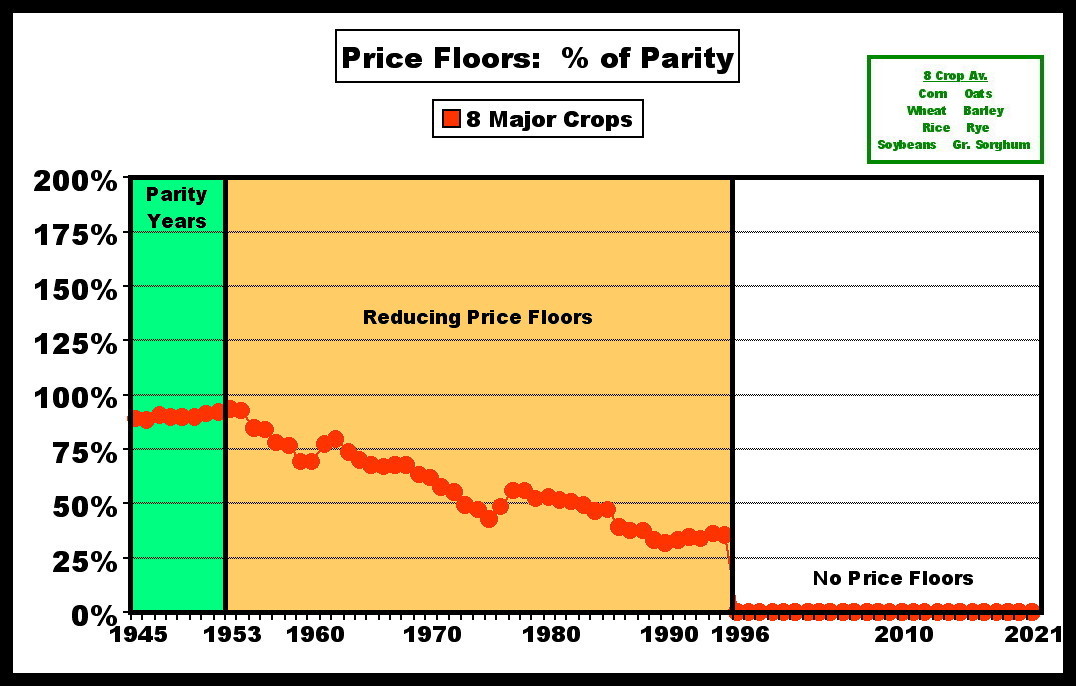
Over the long haul, as farm program benefits have been reduced more and more and more, Republicans have been the top leaders favoring the reductions. Republican farm bill actions have clearly been increasingly anti-farmer for seven decades, as they’ve reduced and ended the parity farm programs of the Democratic Party New Deal. 

By the 1980s it was clear what the differences were between Republicans and Democrats on the farm bill. Republicans called for reducing minimum farm Price Floor levels, (similar in principle to minimum wage floors,) and starting in the 1950s, they consistently mismanaged supply management programs, especially supply reduction programs, causing increased oversupply and cheaper prices. Democrats managed the programs more effectively, consistently reducing oversupply.

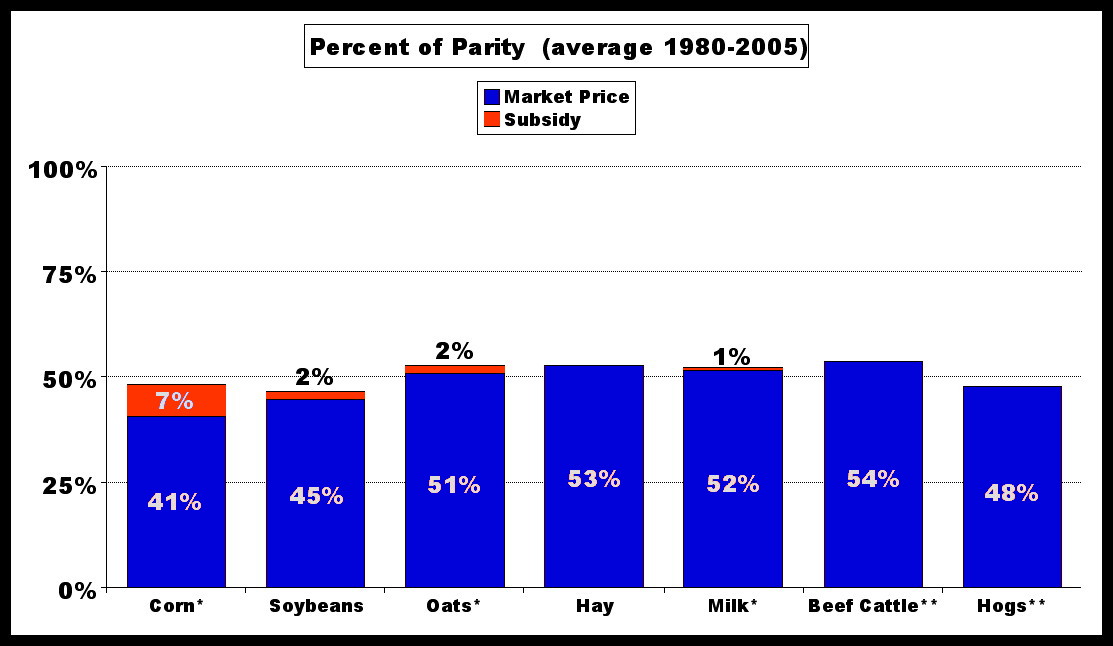
Especially during the 1980s phase of this chronic farm crisis we saw how the Republicans favored farm subsidies, which were not needed under the New Deal programs, which featured higher minimum farm price floor levels. So Republicans became the “big spenders.” During this phase, the chronic farm crisis had snowballed, leading to so many farm foreclosures that collateral values crashed by 45%. Returns on equity for the corn belt fell to double digits below zero for six years in a row. In response, in the 1985 Farm Bill, Republicans further lowered price floor levels by large amounts. They also greatly increased subsidies, but by a lesser amount than the price floor reductions, resulting in lower farm income. 

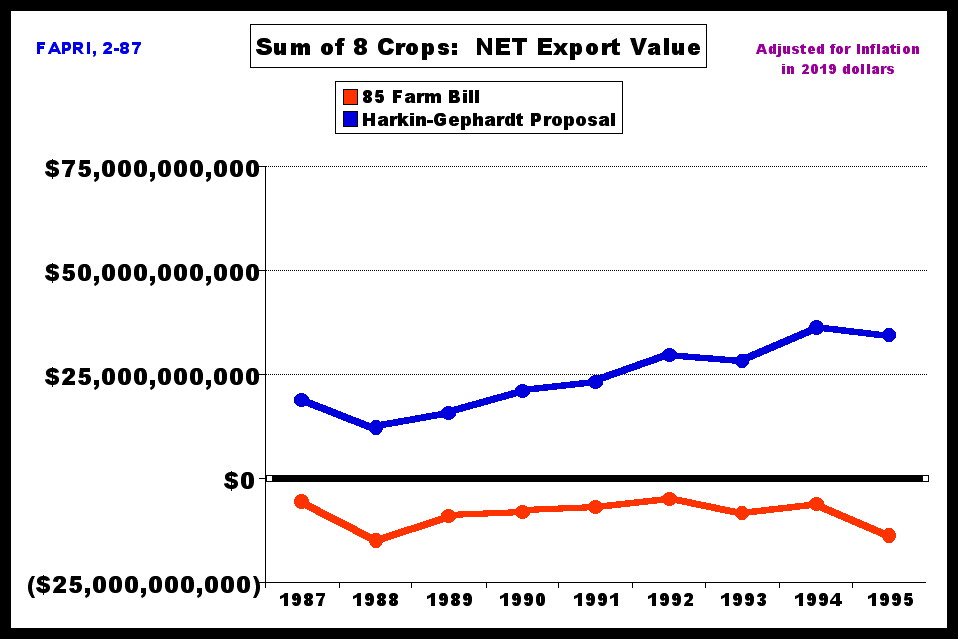
In contrast, during the 1980s and 1990s, rural populist Democrats proposed to restore New Deal Programs, reducing oversupply, raising price floor levels and with no farm subsidies needed. Examples of this include the Harkin-Alexander Bill of 1985 and the Harkin-Gephardt Bill of 1987. Econometric studies of these proposals, in comparison to the 1981 and 1985 farm bills found them to be much cheaper and much better for struggling farmers, with much greater income on farm subsidies. The Democratic proposal would have raised farm prices above full costs, and the U.S. would have stopped losing money on major farm exports, (with the losses falling on farmers, not the giant agribusiness middlemen). These efforts proved to be helpful to the Democratic Party across the major crop farming states.

The Democratic Farm Bills of the 1980s failed to pass in Congress, v, and major farm prices were below full costs every year, 1981-2006, except for 1996. 

Then, in 1996, Republicans ended market management programs, (vetoed, then signed by Democratic President Clinton), while offering “transitional subsidies” for 1996 through 2001. These additional reductions almost immediately and massively failed, as farm prices fell to record low levels, year after year. For example, farmers saw 8 of the 9 lowest corn and soybean prices in history between 1997 and 2005, and other major crop prices were very similar. This created a huge crisis for the Republican Party. Instead of restoring market management programs, however, they poured in a lot more subsidy money, in 4 emergency farm bills, in 1998, 1999, 2000 and 2001. These extra subsidies were then included in the 2002 Farm Bill. They were then reduced in the 2008 Farm Bill, and even more in the 2014 and then 2018 Farm Bills.

Meanwhile, in 2001, Iowa Senator Tom Harkin became Senate Agriculture Chair, and Harkin then led the populist rural Democrats in switching sides, and supporting a slightly greened up version of the 1996 Republican Bill. (I call this “The Harkin Compromise,” and see the reference below.) This “bi-partisan” (Republican) approach then became normalized, and farmers then had virtually no one in Congress to support them on these, the biggest farm policy issues. What Congress did was all for cheap farm prices the giant agribusiness/CAFO buyers, U.S. and foreign. Additionally, in multiple ways, it supported the giant agribusiness input sellers, as supply reduction programs were ended, and most farmers lost all value added livestock, to then lose all of the sustainable livestock crops, grass pastures and alfalfa and clover hay, plus the nurse crops for these, like oats and barley. The results have been devastating for the environment.

Harkin surely believed that switching sides was the right thing to do for the Democratic Party, as he was being criticized for proposing his version of the New Deal farm programs. (Republicans believe that free markets work for agriculture, and that’s the justification for the program reductions. That belief is untrue, however, and especially for agriculture, which “lacks price responsiveness” “on both the supply and the demand side for aggregate agriculture.”) We can see now, however, that since Democrats have stopped supporting fair prices for farmers, they have gone down a lot with regard to winning the rural vote. For example, Iowa has lost all of its Democratic members of Congress.

The Price Loss Coverage Program

Among the farm bill provisions in the House Budget Reconciliation Bill are cuts to the Price Loss Coverage (PLC) farm subsidy program, which is what I’m examining here. PLC is a “countercyclical” farm subsidy program, meaning that it’s the least irrational of these programs. This means that farmers get more subsidies when the need is greater, and less when the need is smaller. The program features subsidy triggers, dollar amounts per bushel, pound or hundredweight, below which a subsidy is given. The subsidy trigger levels are a called Reference Prices.

Here’s an example of how it works, which was given to me by Iowa Republican Senator Charles Grassley a few years ago at a town hall meeting. The PLC subsidy trigger for corn was set at $3.70. If the market price of corn fell to $3.32, then farmers who signed up for this program would get a subsidy. Grassley claimed that they would get the difference, 38¢ per bushel, but that is false. The formula for subsidies includes a 15% reduction, or 85% of the 38¢, (32¢,) and this is then multiplied by a farmers historic yield, (called the PLC Payment Yield). This is based on yields farmers got in the past, which are much lower than current yields. So the per bushel subsidy for the 38¢ reduction below the standard would be 22¢ per bushel. That is then multiplied by base acres, which are generally similar to actual acres of the crop.

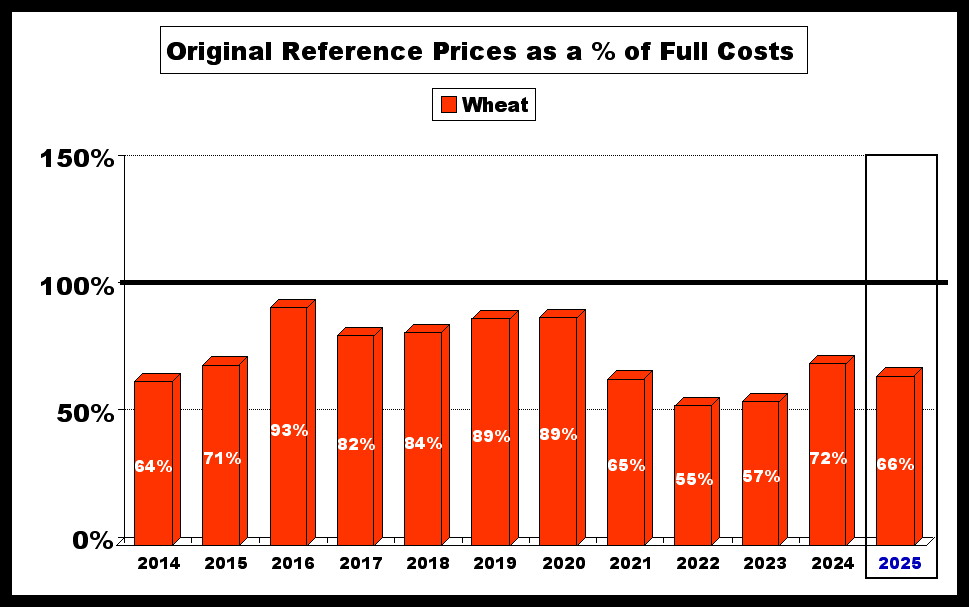
Reference Price standards were set in 2014, with no adjustments for inflation, so the same dollar amounts were used every year, 2014 through 2024. Of course, not being adjusted for inflation, the value of the standards fell lower every year.

Additionally, these subsidy trigger standards were set well below the full costs of production for corn, soybeans, wheat, barley, oats, and grain sorghum, but higher than full costs for rice and peanuts. So in the corn example, farmers would lose money below full costs but not get any subsidy until the prices also fell below the Reference Price standard. Then they would get a subsidy for only a portion of the additional reduction, (for just 58% of the additional reduction in the example above).

A Potential Political Crisis for Farm State Republicans

Farm state Republicans in Congress, such as those on the Agriculture Committees, seem to believe that we’re heading for another farm crisis. We had much higher farm prices under Biden, but inflation from the pandemic plus the war in Ukraine caused farm input costs to rise a lot. This is seen in higher farm cost of production estimates from USDA’s Economic Research Service. Now many expect farm prices to fall. We see that in USDA and CBO projections, for example. That is what typically happens following unusual farm price spikes. 

This translates into a potential political crisis for farm state Republicans. This potential is compounded by the fact that the Republican Project 2025 calls for ending the major farm subsidy programs, (Price Loss Coverage and Agriculture Risk Coverage,) and calls for reducing Crop Revenue Insurance subsidies, the sugar market management program, and the market agreement programs for fruits and vegetables, which have a supply management aspect to them. Project 2025 also calls for the elimination of various USDA programs. Meanwhile, President Trump has been implementing a number of Project 2025 provisions, and making cuts of various kinds to USDA. 

Proposed Republican Reductions for the Price Loss Coverage Program

In response to the current concerns in farm country, House Republicans have proposed to “raise” Price Loss Coverage subsidy triggers, (Reference Price levels). For corn, for example, they propose a raise from $3.70 to $4.10. That’s a raise in nominal terms, (i.e. not adjusted for inflation). If adjusted for inflation, however, it’s a significant decline from the original standard of $3.70 in 2014. 

The factor of adjusting for inflation or not has confused this matter. For example, the agricultural economists at FarmDoc Daily have claimed that the new Republican proposal raises Reference Prices significantly. Others have jumped on this bandwagon, citing FarmDoc Daily, and expressing outrage at the increased subsidies for crops like corn and soybeans, for example United We Eat, and the Make America Healthy Again (MAHA) Movement. I have challenged these claims, showing how, by adjusting for inflation, the PLC program standards have been significantly reduced. 

Here’s what I find. As in the chart below, for the various crops, FarmDoc Daily contrasts the “Existing Statutory Reference Price” with the “Increase Proposed,” for example, the original $3.70 for corn versus the new 2025 standard of $4.10. The “existing” $3.70 could refer to the standard for 2024, or to the standard for 2014, or for any year in between. Because of inflation, however, the value of $3.70 in 2014 is significantly different from $3.70 in 2024. The same applies to the new standards. $4.10 in 2025 does not have the same value as $4.10 in 2030, according to CBO projections of the rate of inflation. Then, for 2031 to 2035, the House proposal raises the standard by ½ of 1% per year, to $4.20 for corn in 2035, for example. FarmDoc Daily ag economists identifies this “Increase Proposed” ($3.70 to $4.20,) as 13.61% for corn. Meanwhile, for 2031-2035, CBO projects an inflation rate of 2% per year, four times as much as the nominal Republican Reference Price increases for those years. So PLC Reference Price standards are also reduced during those years, if adjusted for inflation. 

I’ve created two slide shows to tell this story and with multiple data charts for all of the crops covered in the PLC program. (See links in the References section, below.)

Farm Bill Issues Involve Significant Opportunities and Huge Challenges for Democrats

The PLC issue, in it’s larger farm policy and political context, as laid out here, offers significant opportunities for Democrats. Due to a major lack of knowledge of farm policy history and the history of related political activism, however, Democrats have a steep uphill battle to take advantage of these opportunities. This is not just a problem of what Democratic Party activists don’t know. The bigger problem is that Democrats “know so much that just ain’t so.” So there must be tremendous unlearning before a significant factual approach can be formulated.

At root, in multiple ways, Democrats and progressive activists generally have unknowingly been taken in by a conservative, Republican narrative about farm policy and politics. In the Republican narrative, the issues are all about farm subsidies and government spending. To “follow the money” you look at farm bill spending. That spending goes almost entirely to farmers, not to agribusiness, so the crux of the issue lies in what are believed to be large benefits to farmers, (farmer victims). Benefits to agribusiness exploiters tend not to be seen, or rather, they’re thought to come from farm subsidies. This is all essentially false, as can easily be proven. The biggest flaw is that the farm bill’s market management impacts, from severe reductions over decades, and which are much larger than spending and subsidies, are not found in government spending at all. In effect, they remain invisible to those immersed in this covertly, (unknowingly,) conservative narrative. And yet this much larger unknown part is directly where highly profitable agribusiness exploiters are massively subsidized. And so they are subsidized by these farmer victims, not by taxpayers, and throiugh them, consumers are also massively subsidized by farmers, especially by the subsidized farmers, and especially by farmers raising corn, and operating in corn belt states like Iowa. And the de facto subsidies that farmers pay to agribusiness/consumers are much larger than the government subsidies that taxpayers pay back to farmers as compensations. And meanwhile, as the U.S. so often loses billions of dollars on farm exports, there is very little awareness that it is occurring, let alone what caused it and what can be done to fix it. And the same applies to the massive subsidization of huge CAFO corporations, the resulting massive loss of farms with livestock and poultry, and the subsequent massive loss of farms and acreages of the greatly needed sustainable livestock crops, grass pastures, alfalfa and clover hay fields, and soil protective nurse crops like oats and barley.

We see then that there are numerous important corollaries that have arisen from this core, unknowingly conservative, narrative (which is rooted in dozens of farm subsidy myths, and see the reference for that topic below, as it explores various corollaries). For one thing, Republicans, and farm bills, (and especially Commodity Title programs, and especially farm subsidies,) are thought to be very pro-farmer. Both conservatives and progressives have believed this, in spite of the fact that it’s very false.

At the same time, of course, there are huge and increasing problems in agriculture, especially environmental problems related to pollution and climate, and health problems, but also the decline of rural communities. This part of the narrative is very true.

The narrative then puts these things together with a conclusion that the problems are caused by the farm bill providing huge incentives to farmers growing the main subsidized field crops, such as corn, soybeans, wheat, cotton and rice. The solution is then supposed to be found in “subsidy reforms” which cut subsidies to the vast majority of these farmers, and increase subsidies for conservation and sustainable farming practices. So the vast majority of farmer victims are seen as opponents who are supported by Republicans, and not as allies. Meanwhile, subsidy reform proposals maintain the disastrous Republican free market farm policies, (i.e. no New Deal style market management,) thus continuing to foster chronic market failure, providing the cheapest of cheap farm prices to subsidize CAFOs and agribusiness at the maximum possible level. So this imagined solution is hardly any solution at all. 

One of the biggest falsehoods generating political failure on these issues is the lumping together of farmer victims with agribusiness exploiters, as if they’re on the same side, rather than on opposite sides. This is expressed by various ways by conservatives, such as by referring to the agricultural industry, or corn industry or hog industry. We also have conservative groups advocating on the issues in these ways, such as Farm Bureau, the National Corn Growers Association, the American Soybean Association, and the National Pork Producers Council. So these groups present themselves as farmer led groups, even though their approaches are pro-agribusiness and anti-farmer. On the progressive side, the same conservative narrative is widely expressed, such as with the terms “Big Ag” and “Industrial Agriculture.” In this way, by unknowingly utilizing a conservative, Republican narrative, progressives and Democrats are further divided and conquered. This is further reinforced by groups advocating for sustainable, organic and local farming and against “industrial” “commodity” “Big Ag” farming. In this narrative a nonorganic farm using tractors and combines is “industrial,” while an organic farm using tractors and combines is not. Additionally, in recent years much or most of the advocacy for black and other minority farmers has moved in this false direction and away from the previous unity of the Family Farm (Farm Justice) Movement. Livestock and dairy advocacy has also become siloed. The same is true for the anti-CAFO movement. Urban “Food” and “Environmental” influences have also been important to these intellectual and political failures. These leaders generally have lacked knowledge of the history of the farm bill and farm politics, or rather invented and spread a massive false history of it. (I base these generalizations on my having written more than 200 detailed reviews and review letters of the work of these various categories of activists, and on my many thousands of online interactions and tweets with representatives of these groups.)

Advocating FOR a Farm Crisis is a Very Bad Political Idea

Groups like United We Eat, which mistakenly believe that corn, soybean, and other subsidized farmers have been rewarded by historical farm bills, rather than penalized in total, in relation to other crops and enterprises, and which may also believe that subsidies cause cheap market prices, (they don’t,) have called for further reducing farm program benefits to these huge crops affecting hundreds of thousands of farmers across many states. What they call for, if enacted, could cause a major snowballing of the chronic farm crisis, especially in light of the fact that farm debt has risen to record high levels. This would be a disaster for agriculture, in many major ways, including with regard to the environmental problems. So this is a very serious misunderstanding, with major consequences, including political ones. 

It would run many farmers out of business, leading to larger and fewer farms, which would further encourage the use of labor saving pesticides and fertilizers. It would do nothing to decrease the subsidization of CAFOs, and so would continue the increasing loss of the diversity livestock and the sustainable livestock crops mentioned above. As I’ve said, that then leads to more off farm work in order to survive, which again means less labor for diversity, and more off-farm capital for intensive input farming. This would all add to the loss of the infrastructure and info-structure for diversity, on farms, in rural communities, and across rural regions. That in turn hurts organic and local farmers. Beginning and minority farmers would be especially hurt. Both have been devastated by the farm program reductions of the past seven decades. There would be further losses of rural population and rural communities would see further decline, in multiple ways, as numerous studies have indicated.

Fortunately, there are great and unifying alternatives to be found in the model of the New Deal Farm Programs, as seen in the proposals being offered in recent years to update them. (One of the updates for which I’ve been advocating is to include incentives in supply management programs for helping to bring livestock out of CAFOs and back onto most farms.) Democrats have an awesome legacy to draw upon for this kind of an agronomic, environmental, social and political strategy. The key is for Democrats to learn about their own history of advocacy for just farm policies. As I’ve been arguing with regard to today’s social movement climate and narratives, in the big picture, there’s no significant farm sustainability without farm justice. And that’s what we find in the legacy of the Democratic Party: distributive economic farm justice.

References for This Price Loss Coverage Project

One value of this paper is that it provides further accessibility to the major reference sources that I’m relying upon in this PLC farm subsidy project. I’ve produced two major slide shows and two videos, and references are more accessible in this form than in those forms. Of special concern to me is the availability of this material to the Democratic Party, its leaders and candidates. The PLC issue being raised now by Republicans is a key indicator of the larger paradigm and narrative that can help Democrats to win back the rural vote. This in turn could make it much more possible for Democrats to win on a wide range of important issues unrelated to agriculture, including the protection of our Democracy from corrupt authoritarian and fascist influences. I’ve engaged in many debates with conservatives over these political issues over the past 40 years, and they really have no (Republican) answers to these challenges, where they are the big spenders who have long had us losing money on farm exports. 

It’s not just that a renewed New Deal farm justice paradigm 

My new work on Republican Reductions to Farm Program Benefits in the Reconciliation Bill

My Google Drive Folder with many materials: https://drive.google.com/drive/folders/1_AYKC9ICqz7vb5jfAQNmVjCQ3jVZbinN?usp=share_link

Slide Show: Brad Wilson, “Republicans Propose to Reduce Farm Subsidies,” Slide Share: Brad Wilson, 6/27/25,https://www.slideshare.net/slideshow/republicans-propose-to-reduce-farm-subsidies-pdf/281074684.

Slide Show: Brad Wilson, “Extra: Republicans Reduce Farm Subsidies,” Slide Share: Brad Wilson, 6/27/25, https://www.slideshare.net/slideshow/extra-republicans-reduce-farm-subsidies-pdf-ca8f/281556888.

Video: Brad Wilson, “Republicans Reduce Farm Program Benefits 1,” (“PLC Subsidy Triggers in the House Proposal,) YouTube: Fireweed Farm, 6/26/25, https://www.youtube.com/watch?v=aIiW3dgJmOg&list=PL6A69251AD0413A0D&index=1.

Video: Brad Wilson, “Republicans Reduce Farm Program Benefits 2,” (“More PLC Subsidy Triggers in the House Proposal,) YouTube: Fireweed Farm, 6/26/25, https://www.youtube.com/watch?v=mg5QFCtf51E&list=PL6A69251AD0413A0D&index=2 .

Sources Claiming that Republicans Increased PLC Benefits in the House Reconciliation Bill

A number of Republicans in the House of Representatives have made this claim, including Iowa’s Zach Nunn and Randy Feenstra, and also Secretary of Agriculture Brooke Rollins.

Schnitkey, G., N. Paulson, C. Zulauf and J. Coppess. “Spending Impacts of PLC and ARC-CO in House Agriculture Reconciliation Bill.” farmdoc daily (15):93, Department of Agricultural and Consumer Economics, University of Illinois at Urbana-Champaign, May 20, 2025, https://farmdocdaily.illinois.edu/2025/05/spending-impacts-of-plc-and-arc-co-in-house-agriculture-reconciliation-bill.html.

United We Eat, “MAHA Leaders Urge Rejection of Massive Subsidies to Big Ag in Reconciliation Bill,” United We Eat: 6/12/25, https://unitedweeat.substack.com/p/maha-leaders-urge-rejection-of-massive

MAHA, “To Make America Healthy Again (MAHA) Stop Congress’s New “Big Beautiful Poison Bill” that Harm’s American’s Health,” United We Eat, June 6, 2025, https://unitedweeat.substack.com/p/to-make-america-healthy-again-maha.

More Information about the PLC, ARC, and Revenue Insurance Programs

Brad Wilson, “Dear Ag Sec. Perdue, Why are Peanuts Favored over Corn, Wheat, Soybeans, and 

Oats?” Family Farm Justice, 7/14/17, https://familyfarmjustice.me/2017/07/14/dear-ag-sec-perdue-why-are-peanuts-favored-over-corn-wheat-soybeans-and-oats/.

Video: Brad Wilson, “Wilson V. Grassley 2: Farm Subsidies,” YouTube: Fireweed Farm, 9/11/21, https://www.youtube.com/watch?v=VAJyKU_d7sA&list=PLA1E706EFA90D1767&index=7

Slides: Brad Wilson, “The Case Against Bipartisan Farm Bills,” SlideShare: Brad Wilson, 11/16/22, 

https://www.slideshare.net/slideshow/the-case-against-bipartisan-farm-bills/254542497.

Slides: Brad Wilson, “Democratic Party Farm Programs,” SlideShare: Brad Wilson, 4/23/22,https://www.slideshare.net/slideshow/democratic-party-farm-programspdf/256537282.

Brad Wilson, “Primer: Revenue Insurance in the 2012 Farm Bill,” ZSpace: Brad Wilson, May 11, 

2012, http://znetwork.org/zblogs/primer-revenue-insurance-in-the-2012-farm-bill-by-brad-wilson.

Brad Wilson, “Subsidies vs Price Floors in Farm Bill History, Revised,” Family FarmJustice, 5/25/16, 

https://familyfarmjustice.me/2016/05/25/subsidies-vs-price-floors-in-farm-bill-history-revised/.

Learn About Reform Proposals

“The Farm Policy Reform Act of 1985,” 1985, https://familyfarmjustice.me/2016/12/10/the-farm-policy-reform-act-of-1985/.

National Save the Family Farm Coalition, “Family Farm Act of 1987,” https://familyfarmjustice.me/2016/12/09/family-farm-act-of-1987/ . 

Video: National Family Farm Coalition, “From the Grassroots Up, Not from the Money Down,” YouTube: Brad Wilson: 4/13/21, https://www.youtube.com/watch?v=-ywo1PX9VYI&list=PL7K_XwGI3jVS4AMDeEdFfHALIOYnoWg53&index=4.

National Family Farm Coalition, “Food from Family Farms Act,” IATP: Aug 28, 2006,https://www.iatp.org/documents/food-from-family-farms-act.

Dr. Daryll E. Ray, et al, 

Rethinking U.S. Agricultural Policy, APAC: 2003, https:// 

www.agpolicy.org/blueprint/APACReport8-20-03WITHCOVER.pdf

Video: Brad Wilson, “How to End CAFO Subsidies,” YouTube: Fireweed Farm, 4/30/25, 

Brad Wilson, “Primer: Farm Justice Proposals for the 2018 Farm Bill,” ZSpace: Brad Wilson, 

May 11, 2012, http://znetwork.org/zblogs/primer-farm-justice-proposals-for-the-2012-farm-bill-by-brad-wilson.

Video Playlist: Brad Wilson, “Farm Bill History,” YouTube: Fireweed Farm, https://www.youtube.com/playlist?list=PL7K_XwGI3jVS4AMDeEdFfHALIOYnoWg53.

Farm Subsidy Myths and Other Myths at Lancet

This is my response to a section of the policy brief section of a report, The Global Syndemic of Obesity, Undernutrition and Climate Change: The Lancet Commission report, originally here,https://www.thelancet.com/commissions/global-syndemic . The parent link for that section was originally here:https://marlin-prod.literatumonline.com/pb-assets/Lancet/stories/commissions/obesity-2019/GlobalSyndemicCommission_policybrief.pdf. Find the report now here: https://www.academia.edu/86907593/The_Global_Syndemic_of_Obesity_Undernutrition_and_Climate_Change_The_Lancet_Commission_report

Unfortunately I find problems in their understanding of farm policy, and how it impacts sustainability, climate and public health. Since that is not evidence based, it then taints The Lancet’s approach over all, (and this also applies to Walter Willett generally, I’ve found in the past). According to the policy brief:

Page 4

6 Eliminate subsidies for products that contribute to The Global Syndemic and redirect funding to actions that mitigate it. 

•Increase awareness of the impact of subsidies on the true costs of food and car use to build support for sustainable agriculture and sustainable modes of transportation. 

Redirect existing government subsidies for beef, dairy, sugar, corn, rice, and wheat (about $US0·5 trillion a year) to sustainable farming for healthful foods.

•Redirect subsidies for fossil fuels (about $US5 trillion a year) to renewable energy and sustainable transportation systems.

This is the rooted in a key farm subsidy myth, and I’m convinced that it’s a major factor behind a wide range of anti-farmer public attitudes and academic biases. Economically, they don’t understand that (the data clearly shows that,) the main economic issue is ‘free’ market failure, (the failure of actual agricultural markets for major crops,) which is much bigger in impact than, (and opposite in impact to,) the subsidy compensations, (i.e. U.S. “deficiency payments,”) that everyone knows about. It’s the over all penalization of farmers, (market reductions + subsidies = net or total impacts,) that has been so important in causing these problems, not the myth that farmers have been over-rewarded, (since they’ve received farm subsidies). This is a case where more people need to start showing the evidence, because otherwise the conclusions seem counterintuitive, and just about anyone might go with their intuitions over the evidence.

Basically, (like almost everyone else,) The Lancet supports continuing the maximum of subsidization (from farmers) to CAFOs, (cheap market prices, “implicit subsidies,”) which has led most farms to lose livestock, as the CAFOs can usually purchase feed cheaper than diversified farms can grow it. It then drastically reduces permanent pastures on fragile lands and sustainable crop rotations with green sod crops. It massively damages the whole on-farm, local, regional, national and global infrastructure for diversity (sustainability,) that today’s organic farmers also need. 

That all makes us much more dependent upon fossil fuels, both in the manufacturing of farm inputs and products, but also in the farming itself. In a diversified system livestock can harvest their own feed and spread their own fertilizer over permanent green sod crops for large periods of time, all without much of any fossil fuel impacts. In the other system we produce all sorts of machines and inputs, to be transported to farms, (with much fossil fuel use,) to then prepare, plant, maintain and harvest feeds to be transported to livestock, and with the manure then being stored and transported back to the lands. These enormous differences seem to be invisible to those focusing on, for example, cows belching methane, or as some have put it, ignoring “the how,” to focus only on “the cow.” Either they know nothing about this massive difference in farming systems, or they simply throw the baby out with the bathwater, arguing that since some livestock systems are bad for climate and etc., all livestock systems should be eliminated, (even if they greatly help climate and etc.).

Politically they’re supporting the dividing and conquering of our efforts, farm vs urban, farmer vs farmer,) and continued conservative domination of the rural vote. None of that occurs with a true farm justice solution, which is much more sustainable because it addresses the actual causes of the problems, (not the imagined cause behind these statements,) with much less government spending, and with farmers, farm states, the United States and farming countries being paid much more fairly, (such as being paid above the cost of production on export sales). They basically claim that farmers have been over-rewarded! There isn’t any valid evidence to support that. They’re clearly relying only on invalid evidence, (that subsidies exist and are paid to farmers in certain amounts). 

Consider the logic behind EAT Lancet’s claims. Hungry people in inner cities get the bulk of food subsidies. That doesn’t prove that they’re big economic winners with the same strategic interests as “big food,” the dominant lobby, etc. Their subsidies are a kind of correlation evidence. They correlate with all kinds of social problems. That isn’t evidence that the food subsidies cause those problems, or that eliminating food subsidies would end poverty in inner cities and such. But that’s the principle of logic that The Lancet is using, applied to farm subsidies.

EXPANDED THOUGHTS

Also implied in The Lancet’s farm policy proposal is that they don’t know about the problems of oversupply that cause such cheap market prices that then contribute so strongly to global rural poverty and hunger. Nearly 80% of the global “undernourished” are rural, as is nearly 70% of the population of Least Developed Countries. (The percentages have been dropping as people flock from rural poverty areas to urban ghettos.) The Lancet, in ignoring this problem while trying to subsidize a shift to greater food production, would make global rural poverty worse, not better, because such a shift would lower global farm prices for the various crops. 

A key question for these people is, are they adequately addressing over population? All kinds of proposed solutions will fail eventually, if nothing is done about population, (which is also tied to poverty). If the solution is a switch to manufactured food, that places it into the hands of authoritarian agribusiness megamachines. That’s even more likely to make global rural poverty worse.

In general, I think that The Lancet doesn’t know the difference between the fossil fuel subsidies and farm subsidies. Farm subsidies are like food subsidies, (SNAP, food stamps). They’re paid to people being greatly underpaid by the larger economy, leading to all kinds of problems. But you can’t fix the problems of inner cities by cutting food subsidies and other welfare payments to the victims, (on the argument that the problems are caused by over-rewarding them). You need to fix the larger problem of economic exploitation which is unrelated to food subsidies and welfare. Unfortunately, this is the principle behind The Lancet’s (unsubstantiated) theory or opinion on farm subsidies.

One missing piece is that the farmer subsidies to agribusiness buyers, (cheap, below cost farm prices,) are paid even though agribusiness, unlike farmers, has never shown any need to be subsidized. So agribusiness get the subsidies (from farmers,) without any prior deficiency.

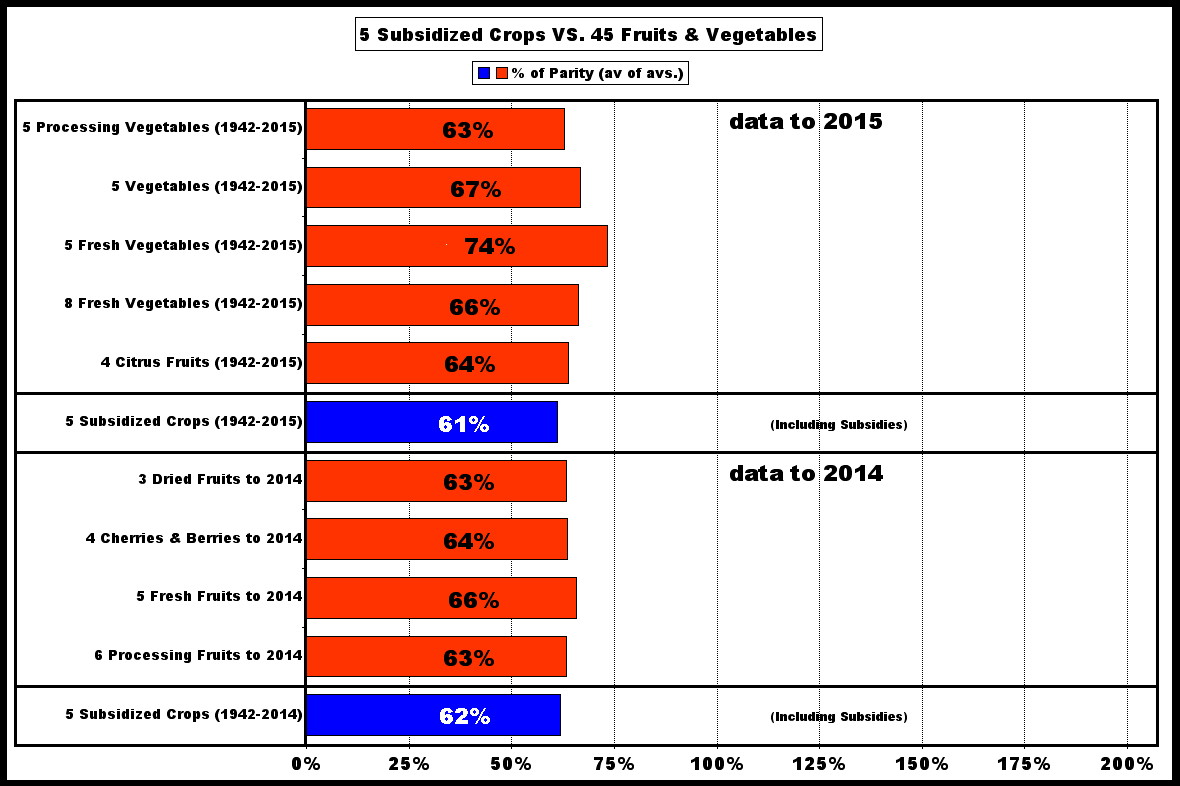
EAT Lancet’s middle point, in bold, is based upon a spending paradigm, that treats the larger economy as an acceptable given, to be ignored, with “follow the money” only applying to government spending. (Again, applied to SNAP, that would show the hungry as the dominant winners, since they get so much money). What’s missing is the (economic) chronic market failure of US and global agriculture, (on both supply and demand sides, http://agpolicy.org/weekcol/248.htmlhttp://agpolicy.org/weekcol/325.html) and the (political) reduction and elimination of the government market management policies that previously fixed these market failures. Grain, soybean and cotton farmers, then, are the biggest victims, paid less, even with added subsidies, than 45 fruits and vegetables (measured by % of parity, https://www.slideshare.net/slideshow/subsidized-crops-vs-vegetables-pt-i/239258118,https://www.slideshare.net/slideshow/subsidized-crops-vs-fruits-pt-2/239258054) even as all crops were reduced over 7 decades. Subsidies provide a small and fairly ineffective amount of justice to remedy that, and The Lancet wants to remove even that. 

So market failure, combined with farm bill market management reduction (1953-1995) and elimination (1996-2023) caused the problems in various ways*. What’s overwhelmingly needed for sustainability, the evidence clearly shows, (https://familyfarmjustice.me/2022/07/31/you-cant-fix-sustainability-without-justice/) is restoration of adequate US and global market management, (esp. price floors and supply reductions). Proposals are available from the National Family Farm Coalition, the National Farmers Union, The Campaign for Family Farms and the Environment, and the Texas Farmers Union, plus various proposals for dairy. No subsidies are needed.

*What’s happened is that Congress has become colonized by multinational corporations, so that they ignore chronic farm market failure, and allow prices to drop to the lowest possible levels, such that we lose money on major farm exports and sales out of farming states and communities for decades at a time, setting extremely low global market prices, causing massive poverty and hunger across the rural half of the world. The Lancet proposal offers nothing to address this, but instead fosters the maximization of US and global farmer exploitation by agribusiness buyers. They apparently aren’t able to conceptualize this larger paradigm. Again, the cheap prices have led to the loss of livestock from most farms, which has greatly reduced the permanent green cover of pastures and as part of sustainable crop rotations, (and increased corn and soybean production). Again, this has been a major assault on grazing systems, as they must compete with the (massively farmer-subsidized) CAFO systems. Again, it’s caused by the penalization of corn and soybeans and the sustainable crops they have replaced, the evidence clearly shows. The alleged over-rewarding that is claimed has not existed. So unknowingly, the Lancet is calling for maintaining the current destructive system with the enormous pot of money, (paid by farmers,) that comes from chronic free market failures, while also reducing the compensations to the biggest victims. And then attempts are made to use subsidies in ways that can easily foster overproduction of other crops, and make sustainable farming less profitable. 

Here we should note Tom Philpott’s proposal to take 10% of the corn and soybean land in 10 midwestern U.S. states to plant to fruits and vegetables. If done, that would increase the supply of fruits and vegetables by 160%, (to 260%,) thus crashing markets.

(To spell it out more clearly,) The Lancet supports the continuation of the maximum of the massive subsidies paid by corn and soybean farmers to CAFOs and export dumpers, while relying on government payments to fix things after the fact. Again, in the real world, these subsidies back to farmers have always been much smaller than the market reductions they started out with. They’ve also been shrinking in each farm bill, (2008, 2014, 2018), and there were no regular farm commodity subsidies paid to most farmers growing corn, soybeans and other crops in 2018, (i.e. to the 90%+ farmers in ARC). 

These findings point toward a conclusion that this seems to be just another group of high status scientists who don’t know how to be evidenced based on issues that are too far afield from their major fields of study, and who therefore rely on the opinions of others, such as mainstream media and the Food Movement leaders like Michael Pollan, (https://znetwork.org/zblogs/michael-pollan-rebuttal-four-proofs-against-pollans-corn-subsidy-argument-by-brad-wilson/, cf. https://zcomm.org/zblogs/philpott-bittman-imhoff-lappe-are-wrong-about-tim-wise/) (neither of which have ever offered any valid, practically significant evidence in support of the alleged subsidy problems or subsidy reform theory).

Here’s some further reading. 

On the dozens of farm subsidy myths and corollary myths. https://drive.google.com/drive/folders/1ZIOiwv1Nr6jn9SsnE62z1P_hitZKTBaD

Diana Rogers, “20 Ways EAT Lancet’s Global Diet is Wrongfully Vilifying Meat,” Sustainable Dish, 1/17/19, https://sustainabledish.com/20-ways-eat-lancets-global-diet-is-wrongfully-vilifying-meat/

Nina Teicholz, “EAT-Lancet Report is One-sided, Not Backed by Rigorous Science,” Nutrition Coalition, January 29, 2019, https://www.nutritioncoalition.us/news/eatlancet-report-one-sided.

Church Statements on the Rural Crisis

PrairieFire Rural Action – NCCC 

(Iowa Family Farm organization) – (National Council of Churches of Christ) 

ECUMENICAL AND INTERFAITH STATEMENTS and POLICY STATEMENTS OF THE NATIONAL COUNCIL OF THE CHURCHES OF CHRIST IN THE U.S.A. 

In recent years, ecumenical bodies at the state and national level have taken an increasingly active and public role on rural crisis issues and state and federal farm policy. 

The first document in this Section is “A Resolution by Religious and Ecumenical leaders of the United States,” passed by an ecumenical and interfaith gathering of religious leaders in Kansas City, Missouri, in November, 1986. The Resolution stands in clear support of the principles of the Family Farm Act. 

Also included here is a “Declaration on Rural Crisis” adopted by the National Interreligious Conference on Rural Life, held in Chicago in February, 1987. This Conference of Christians and Jews marked a major step in the development of strong interfaith policy positions on rural issues and public policy development. 

The National Council of the Churches of Christ in the U.S.A. (NCC) is comprised of thirty-one communions — Protestant, Orthodox and Anglican church bodies with a combined membership of 40 million Christians. It is the primary national expression of the ecumenical movement in the United States. 

This special section includes the NCC’s basic Policy Statement adopted in 1958, “Ethical Goals for Agricultural Policy,” and six related Resolutions passed by the Governing Board since 1983: 

1. On the Status of the Family Farm May 12, 1983 

2. On the Status of Black-Owned Farm Land in the U.S. November 11, 1983 

3. A Call for Justice and Action May 17, 1984 

4. On the Exploitation of the Rural Crisis by Extremist Organizations November 8, 1985 

5. Save The Family Farm Act of 1986 November 6, 1986 

6. Resolution on the “Christian Identity” Movement November 6, 1986 

Of special note is the Resolution passed unanimously by the Governing Board on November 62 19861 in support of the Save The Family Farm Act of 1986. 

National Council of the Churches of Christ, 475 Riverside Drive, New York, NY 10115 

RESOLUTION ON THE STATUS OF THE FAMILY FARM

(Adopted by the Governing Board, May 12, 1983) 

In order to restore some integrity to farm tax and credit policies which have increasingly favored high-income: expanding firms at the expense of small and modest sized family farms in the U.S., the Governing Board of the National Council of the Churches of Christ in the U.S.A. calls upon the Congress and the Administration to develop and implement policies which: 

(1) restore the limited resource loan program of loans to low-equitv and low-income farmers and establish it as the principal loan program of the Farmers Home Administration; 

(2) restructure eligibility guidelines for all other Farmers Home Administration farm loan programs so that larger-than-family farms are not eligible for this kind of assistance: 

(3) provide proper servicing to borrowers who for no fault of their own are unable to meet scheduled loan payments but who show evidence of ability to pay when agricultural prices stabilize at levels which afford them the opportunity to do so; specifically, loan deferrals should be granted on a case-by-case basis under provisions which guarantee full and fair consideration of each applicant for a deferral and which safeguard the procedural rights of the borrower, including the right or administrative appeal; and 

(4) eliminate the use of the investment tax credit for specialized farm buildings for the production of livestock and for the purchase of irrigation equipment which is used to irrigate land which is not considered to be irrigable within soil conservation standards.

The Governing Board further cells upon its member denominations, local congregations, end affiliate organizations to advocate for and support such measures.

Resolution on THE STATUS OF THE FAMILY FARM 

Introduction

One of the most complex problems facing the United States government today is the financial crisis in agriculture. Partly the product of farmers’ success in improving productivity and partly the product of farm policies which have failed to stabilize farm income. this crisis threatens to erode the family farm base of American agriculture more than any development in our lifetimes. 

Neither recent Congresses nor recent administrations have responded responsibly to this growing crisis. To the contrary, there has been a tendency on the part of public officials to avoid the issue by opening public credit programs to an ever-wider group of larger farms and offering tax concessions which encourage further expansion on the part of these farms. The result is more concentration in production, diminished economic opportunity for farms of modest means. and greater financial vulnerability for our food system as a whole. These trends undermine an owner-operated system of agriculture, which a substantial body of scientific literature has established as the most efficient unit of production.

Particularly grievous has been: (1) the steady deterioration in the services afforded small farmers with limited resources by the Farmers Home Administration and the corresponding shift in that agency’s emphasis to larger-than-family farms: and (2) the expansion of the investment tax credit, a superfluous subsidy to capital which invites unneeded investments by tax-motivated investors in areas of agriculture already sufficiently capitalized. These policies have tended to reward the rich at the expense of the poor, and to diminish economic justice. 

The general direction of these and other policies is therefore viewed as contrary to the Ethical Goals for Agricultural Policy adopted by the General Board of the National Council of the Churches of Christ in the U.S.A. on June 4. 1958, which called for the development of “… programs which will enlarge the opportunities for low-income farm families to earn adequate incomes and achieve satis- factory levels of living…” 

Background Considerations 

Credit: Since the 1940’s, the Farmers Home Administration has provided credit as a last resort to farmers who could not get it elsewhere. Its purpose has been to help tenant farmers become owners and to help marginal farmers reach the point where they could operate through normal commercial credit. 

In recent years, the government has reduced services to such farmers while expanding Farmers Home Administration credit to larger, more aggressive farmers. In 1978, Congress eliminated the interest subsidy from 80% of Farmers Home Administration’s “regular” loans. reserving the lower interest loans “limited resource” (LR) borrowers, vaguely defined as those who could not afford the regular interest rate. At the same time, Congress established an Economic Emergency (EB) loan program for larger-than-family-sized farmers including those who do not depend on farm income for a living. By 1979, the EEprogram was larger than the regular loan program, and limited-resource borrowers, the group for whom Farmers Home Administration was established, were getting less than 10% of the agency’s farm loans. 

The present Administration has opposed re-authorization of the limited resource program and has opposed any appropriation for it. Last year, it spent only half the limited resource allocation, despite authorizing legislation requiring it to make the loans. Meantime, Congress, is considering legislation to strengthen the EE program by making it mandatory. 

At the same time, the Administration has generally resisted efforts to take Farmers Home Administration procedures more open and fair for the borrower. This has been particularly true in the case of requests for deferrals, or one-year extensions of overdue loans in cases where the delinquency is for reasons beyond the borrower’s control. A U.S. District Court case (Curry 7. Block) requires the Administration to develop criteria for such deferrals, but Farmers Home Administration has appealed the case to the Circuit Court. Congress is considering legislation requiring implementation of the deferral policy. About 25% of Home Administration borrowers are delinquent, and that proportion is expected to increase. 

Tax Policy: The general effect of U.S. income tax policy on the structure of American agriculture has been to encourage non-farm investment, concentration of production, and the separation of ownership from operation. Recent major studies by the United States Department of Agriculture and land-grant universitiesconfirm this.

The effect has been particularly strong in livestock production which h= become more capital-intensive and therefore more susceptible to tax-motivated investment. The University of Missouri reports that about 13% of the slaughter hogs in the U.S; now come from large operations, and in Nebraska, the Center for Rural Affairs has documented that 24% of the feeder-pig crop (an especially important crop for beginning farmers) now comes from corporate hog factories.A high-income investor in such a facility can receive as much as 50% of his her initial investment back in the first year of operation through reduced federal taxes, and over the life of the facility can receive as much as 80%. This subsidy is attracting investment capital into an area of agricultural production which is already sufficiently capitalized. United States Department of Agriculture reports that the U.S. hog industry presently has about double the productionfacilities necessary to meet production requirements. 

Irrigation development is another example. New technologies (sophisticated sprinkler systems) have made it possible to irrigate marginal range land which is highly susceptible to erosion. A high-income developer and investor can recover about one-third of the purchase price of such land through federal and state tax breaks on the irrigation development, according to the Center for Rural Affairs. Ironically, the tax breaks work to encourage the selection first of those parcels which are most vulnerable to erosion (the higher the ratio of development costs to original purchase price of the land, the larger the tax breaks; the lover the purchase price, the more marginal the land). Most of the production from these developments is corn, a commodity already in surplus. 

Theological Rationale 

A Christian ethical approach to agriculture begins with the acknowledgment that “The earth is the Lord’s and the fulness thereof…” God the Creator has given human beings a special position in the world, with specific responsibility for the fruits of tie earth and all living things. Thus the production of food and fiber — the primary task of farmers — becomes a service to God and humankind. 

The Christian faith also attaches special significance to the family, where Christian love and forgiveness can be personally experienced. The family farm has provided, throughout our history, that type of rural environment most co to the growth of human personality, the stability and enrichment of family life, and the strength of the community and its institutions. This pattern of agriculture he also contributed notably to national strength and the preservation of democratic attitudes and practices. 

Therefore, the preservation and extension of the efficient family-type farm as the predominant pattern of American agriculture has been affirmed as a conscious goal of national policy by the National Council of the Churches of Christ in the U.S.A. Furthermore, the Christian concept of justice demands that family farmers who produce efficiently and abundantly, where such production is in the national interest, should not suffer from this fact, but should receive economic rewards comparable with those received by persons operating larger-than-family-type farms or by persons of similar competence in other vocations. 

Because of their ineffective bargaining position, farmers have rarely enjoyed true parity of income in the open market except during wartime periods of extreme demand. Yet sustained farm income is essential both as a requirement of justice for farmers – and of stability for the total economy. Therefore, programs designed in accordance with sound economic principles and equitably administered to protect the rights and interests of small as well as large farmers are a legitimate and necessary function of the federal government. 

————————————————————————————————–

1. A commonly accepted definition of the “family farm” is a farm operation in which the responsibility of ownership, management, financial risk and labor (except at peak seasons) is that of the family. 

2. The economic literature on economies of scale and farm size are voluminous and conclusive. A farm which fully employs one or two persons achieves lowest costs and optimum efficiencies. The classics in this literature are: J. Patrick Madden, Economies of Size in Farming, AER Report #107, USDA, 1967, Warren R. Bailey, The One-Man Farm, ERS-519, USDA, 1973; and Thomas A. Miller, et al, Economies of Size in U.S. Field Crop Farming, AER Report #472, USDA, 1981. The entire issue was reexamined by USDA as part of the “structure of agriculture” project conducted by the agency in 1980. It confirmed previous findings that “most of the technical economies…are attained at relatively small sizes” and concluded that “we have passed the point where any net gain to society can be claimed from policies that encourage large farms to become larger”. (A Time to Choose, USDA, January 1981.) 

3. Two of the Studies: A Time to Choose, January 1981, USDA Ch. 6, “Tax Policy” pg. 90-99. The Effects of Tax Policy on American Agriculture, Charles Davenport, Michael D. Boehlje, David B.H. Martin, USDA/ERS, Agricultural Economic Report #480. February 1982. 

4. “Ethical Goals for Agricultural Policy”, Statement adopted by the General Board of the National Council of the Churches of Christ in the U.S.A., June 4, 1958. 

RESOLUTION ON THE STATUS OF BLACK OWNED FARM LAND IN THE UNITED STATES

Adopted by the Governing Board of the National Council of the Churches of Christ, November 11, 1983 

According to the Census in 1978, the rate of Black farmland loss was two and a half times greater than the loss rate for white farmers. Black farmers as a group, compared to other farmers, depend more heavily on farming for an income and have less off-farm income. The continuing loss of ownership and control of agricultural land by Black American farmers has reduced their ability to achieve economic viability and financial independence. This loss has been accelerated by the Black land owner’s lack of access to capital, technical information and legal resources needed to retain and develop agricultural land holdings into stable, income-producing self-sustaining operations. 

Resolved: that the Governing Board of the National Council of the Churches of Christ in the U.S.A. calls upon the Congress, the Administration and in particular the United States Department of Agriculture to develop and implement a Federal program designed; 

1) to prevent the loss of ownership of agricultural land by Black Americans; 

2) to assist Black Americans to acquire such land or to expand present holdings; and 

3) to achieve a significant increase in the participation of Black American owners of agricultural land in applicable Federally sponsored programs. 

This program should: 

1) identify, reduce and eliminate barriers which have resulted in reduced participation by Black farmers in, and reduced benefits from, Federally sponsored programs. 

2) provide technical assistance to Black Americans who seek to develop or upgrade land for agricultural purposes, 

3) identify Black Americans who may wish to acquire land for agricultural purposes and to target applicable existing Federal programs to assist in such acquisition, and 

4) encourage the development of private-sector initiatives directed toward the achievement of these objectives. 

The Governing Board,concerned about the increasing disappearance of American small farms, especially those owned and operated by American Blacks, urgently calls upon its-member denominations, local congregations and affiliate organizations to advocate and support these measures. 

Policy Base: Ethical Goals for Agricultural Policy June 4, 1958 

BACKGROUND STATEMENT REGARDING PROPOSED RESOLUTION ON BLACK OWNER FARM LAND

Psalm 24: The earth is the Lord’s and all that is in it, a the world and those who dwell therein.

Isaiah 58:6 Is not this what I require of you…to loose the fetters of injustice…. 

A Christian ethical approach to agriculture begins with the acknowledgment that “The earth is the Lord’s and the fullness thereof…” God the Creator has given human beings a special position in the world, with specific responsibility for the fruits of the earth and all living things. Thus the production of food and fiber — the primary task of farmers — becomes a service to God and humankind. 

Land development promotes community stabilization, creates opportunities for profitable investments and benefits local and national economies by strengthening the economic independence of farmers and creating profitable markets for goods and services. 

During a ten-year period ending in 1978, Blacks lost 57 percent of their active farmland base — down from 133,000 operating farms comprised of 6.2 million acres in 1969 to 57,000 farms and 4.2 million acres in 1978. The two million acre loss over 10 years is conservatively valued at 1 billion dollars. 

Farmland is included in the Census of Agriculture count every five years if it produces an income for its owner of at least $1,000 a year. The Census has an information base on only those Blacks who derive at least $1,000 in farm sales a year. They numbered 57,000 controlling 4.2 million acres in 1978. 

The Emergency Land Fund, Atlanta,- Georgia, und r contract to the Farmer‘s Home Administration. U.S. Department of Agriculture, made a study of “The Impact of Heir Property on Black Rural Land Tenure in the Southeastern Region of the United States” in 1980 and developed the following data: 

“In 1974, Blacks owned or had access to 9.5 million acres with as many as 1.6 million individual Black owners who were scattered throughout the United States with a land title in the rural Southeast. Therefore, over two-thirds of the Black farmland base, some 5 million acres, receive no policy attention, and most certainly none of the program resources available through public supported agricultural institutions. This category of “unaccounted for” Black rural land 

is often idle, subject to absentee ownership, occupied by elderly individuals who are often on public assistance, who in many cases cannot read or write well, if at all, encumbered with clouded titles, lost in tax, partition and foreclosure sales and an easy prey for land speculators. According to the Census in 1978, the rate of Black farmland loss was two and a half times greater than the loss rate for white farmers. 

“Black farmers as a group, compared to other farmers, depend more heavily on farming for an income and have less off-farm income. Additionally, the net farm and farm-related income earned per dollar value of land and building represents a 15% return on investment by the Black farmer compared to the 9% average for all farms. Blacks, therefore, are good farmers but continue to lose land because of a lack of farm financing and operating capital, and suffer also because of the lack of land utilization information. technical and management assistance and markets. There is also a host of legal. financial and discrimination problems that are contributing factors. Often these problems involve both public and private lending institutions, courts, legal representation and land speculators – both private and corporate.” 

Secretary Block of the U. S. Department of Agriculture appointed a special Task Force on the “Decline of Blacks in Agriculture” in April 1983. The information in this resolution will support the Emergency Land Fund’s recommendations to that Task Force. 

Based on NCCC Policy Statement:  Ethical Goals for Agricultural Policy, June 4, 1958. 

———————————————————————————————

l. The Emergency Land Fund was founded-in 1971 by Robert S. Browne, who is also the founder of the Black Economic Research Center and the Twenty-First Century Foundation. For the past eleven years, ELF has maintained a regional focus, working throughout the rural Southeast providing a variety of services and conducting special projects and programs aimed at the retention, acquisition and better utilization of farmland for the benefit of Blacks. ELF’s services include legal, financial, technical and management assistance. Additionally, ELF has maintained an extensive outreach and community education program. Emergency Land Fund, Joseph Brooks, President, 564 Lee Street, S.W., Atlanta, Georgia 30310 (404) 758-5506 

A RESOLUTION

of the 

NATIONAL COUNCIL OF THE CHURCHES OF CHRIST IN THE U.S.A, 475 Riverside Drive, New York, NY 10115 

Resolution on the Exploitation of the Rural Crisis by Extremist Organizations 

(Adopted by the Governing Board November 8, 1985) 

The Governing Board of the National Council of the Churches of Christ in the U.S.A.: 

Endorses as its own statement the resolution adopted on April 13, 1985, by the Iowa Inter-Church Agency for Peace and Justice, an agency of the Iowa Inter-Church Forum, and member of the Iowa Farm Unity Coalition: 

“We deplore and reject the extremist philosophies and actions of those individuals and organizations that promote violence, anti-semitic, or racist responses to the Farm Crisis, and reaffirm and recommit our efforts and energies to building a constructive, progressive, non-violent farm movement that is committed to justice for all people of this nation and the world.” 

(2) Urges the member communions to communicate this Resolution to their congregations along with materials which will inform them about this racist and anti-semitic campaign, and how to combat it. 

Policy Bases: “Religious and Civil Liberties in the United States of America,” adopted by the General Board October 5, 1955.  “Ethical Goals for Agricultural Policy,” adopted by the General Board June 4, 1958. 

A RESOLUTION of the NATIONAL COUNCIL OF THE CHURCHES OF CHRIST IN THE U.S.A.

475 Riverside Drive New York, NY 10115 

Resolution on the Save-the-Family-Farm Act of 1986 

(adopted by the Governing Board, November 6, 1986) 

The Governing Board of the National Council of the Churches of Christ in the U.S.A. endorses 

(1) The objectives of the Save-the-Family-Farm Act of 1986, which incorporates a strong supply-management program; price supports that cover at least the cost of production; a producer referendum that will enable farmers and ranchers to determine their own future; and a minimization of the financial burden of federal farm programs on the taxpayer. 

The Governing Board of the National Council of Churches instructs 

(1) The General Secretary to ask Congress and the appropriate Committees of Congress to docket this proposed legislation for immediate consideration upon the convening of Congress in January 1987. 

(2) The General Secretary is also instructed to inform the President of the United States and the Secretary of Agri- culture of this action by the National Council of Churches and our expectation for support from the administration. 

Policy Base: Ethical Goals for Agricultural Policy, June 4, 1958. 

For presentation to Document_________

NCC Governing Board

November 5-7, 1986 

Resolution on the Save-the-Family—Farm Act of 1986

Since 1984 the Rural Crisis Issue Team, an ecumenical group of staff persons, responding to a directive from toe Governing Board of the National Council of Churches, has been advocating change in the legislation governing the farm economy. The directive from the Message, “Rural Crisis: A Call for Justice and Action”, states the following: 

“to press for enlightened public policy that will preserve the diverse ownership of land and the continuation of the family farm system with its attendant values of stewardship, family, and community responsibility through education and organized action within the congregations of our member Communions.” 

The Governing Board has put the National Council on record in Resolutions to support the status of the family farm as it relates to farm tax and credit policies, loss of Black-owned farm land, to warn against extremist organizing in the rural communities, and to respond to the economic development needs from the drought crisis on the farms in the southeastern states. 

The Federal Office of Technology Assessment, Spring 1986, stated that “if present trends continue to the end of this century, the total number of farms will continue to decline from 2.2 million in 1982 to 1.2 million in 2000“.

Legislation to reopen the debate on the problems facing family farmers was introduced into the Senate and the House of Representatives on September 23, 1986. The Save-the-Family-Farm Act of 1986 challenges the Food Security Act of 1985, the most recent legislation on farm policy. The new legislation is supported by a broad-based coalition of farmers, consumers, laborers, church leaders, small businesses, bankers and community leaders. The Save-the-Family-Farm Act seeks to control overproduction of farm products while restoring supply/demand balance to the marketplace. It is designed to save dollars for the taxpayer and save America’s family farms and rural communities. 

The Governing Board of the National Council of Churches endorses the objectives of the Save-the-Family Farm Act of 1986, which incorporates a strong supply-management program; price supports that cover at least the cost of production; a producer referendum that will enable farmers and ranchers to determine their own future; and a minimization of the financial burden of federal farm programs on the taxpayer. 

The Governing Board of the National Council of Churches instructs the General Secretary to ask Congress and the appropriate Committees of Congress to docket this proposed legislation for immediate consideration upon the convening of Congress in January 1987. 

The General Secretary is also instructed to inform the President of the United States and the Secretary of Agriculture of this action by the National Council of Churches and our expectation for support from the Administration. 

Note accompanying analysis of Save-The-Family-Farm, Act of 1986. 

RESOLUTION ON THE “CHRISTIAN IDENTITY” MOVEMENT

Since its beginnings, the National Council of Churches has voiced opposition to all forms of racism and anti-semitism. It has expressed concern about the recurring signs of Nazism and for the victims of Klu Klux Klan violence. In the Theological Statement of Racial Justice, the Governing Board reiterated this concern when it stated that: 

“Racism is an expression of idolatry replacing faith in the God who made all people and who raised Jesus from the dead with the belief in the superiority of one race over another or in the universality of a particular form of culture.” 

Because of the “Christian Identity” movement’s ideological under- girding for racist violence, it represents a threat to the Christian understanding of the Gospel. “Identity” doctrine is preached at rallies by the para-military White Patriot Party in North Carolina, at survivalist encampments in many sections of the Midwest, and in the halls of the Aryan Nation in the Pacific Northwest. “Christian Identity” played a major role in The Order, an armed criminal underground organization. In addition, Identity ideology has promoted a practical working unity among geographically disparate organizations and groups. 

“Christian Identity” centers around the belief that the people of Northern Europe — white Anglo-Saxons — are the Ten Lost Tribes of Israel. Jews are considered to be the Children of Satan, and racial ethnic people are considered to be “pre-Adamic” — a lower species than people of European ancestry. 

“Christian Identity” is neither a single organization nor a monolithic doctrine. Instead it is composed of hundreds of small groupings throughout the United States. It is not confined to any single region of the country, and small Identity churches exist in metropolitan areas like Los Angeles and in the rural hills of Arkansas. Some Identity groups are directly engaged in political action — often violent political action and others are content simply to pass their racist heritage on to their children. Therefore, the most helpful model with which to understand “Christian Identity” is to regard it as a movement rather than a denomination. The Identity movement is composed of interactive parts that continually develop and re-develop its ideological and organizational expression. 

The development of para-military activity within the Identity movement is tue result of a convergence of the impulse towards armed violence within the general racist population and an impulse towards armed activity from within Identity ideology itself. Any analysis of para-military activity within the Identity movement must take both sources into account. “Christian Identity” has emerged as a primary religious and spiritual orientation of the Far Right. It incorporates the major neo-Nazi themes, while maintaining itself as an “American” phenomenon. Recently the U.S. has been undergoing a resurgence of bigotry under the guide of Christianity. This resurgence is a deep, ugly stain in American society. 

THEREFORE BE IT RESOLVED that the Governing Board of the National Council of Churches of Christ in the USA: 

Reaffirms its commitment to Racial Justice and its opposition to the ideology of the “Christian Identity” movement.

2. Condemn the Identity movement’s perversion of Christianity as a pretext for hatred, racism and anti-semitism. 

3. Calls on its member communions to educate their constituencies about the nature and purpose of the “Christian Identity” movement. 

4. Calls on the Division of Church and Society to keep the NCCC member communions informed about the “Christian Identity” movement. 
Rural Crisis: A Call for Justice and Action

Message adapted by the Governing Board of the National Council of the Churches of Christ in the U.S.A., May 17, 1984

THE CRISIS OF THE PEOPLE OF THE LAND

We warn that America is teetering on the slopes of a dark precipice: we are dangerously close to abandoning the egalitarian and communitarian goals of our religious and social heritage. We are well on the way to becoming a landless and fragmented people subject to the whims of those few holding disproportionate wealth and power.

Like our ancestors of the Farmers Alliance of 100 years ago, our cry seems to be lost in the void. Then, as now, family farmers were being driven off the land due to a mixture of high interest rates, low prices for farm produce, and a stagnant economy. Now, as then, the people of the land are told that this is the result of the inevitable march of history, that this disenfranchisement of the people from the land marks a steady onrush of the tide of progress. One hundred years ago the people of the land looked in vain to their elected representatives for assistance. Now, as then, our congress has favored the proponents of the “trickle-down” theory of economics, allowing the wealthy to pile riches upon riches while the people of the land diminish in number.

Our present period of crisis is unparalleled since the days of the Great Depression. An economic crisis in agriculture – one result of decades of public policy aimed at displacing people from the land – hastens the demise of our family – owned and operated – farms. Ownership and control of our rich land base is being consolidated at an alarming rate, and the loss of farms and people from the countryside is causing serious economic problems in our rural communities. Our cities re experiencing high unemployment rates among workers associated with agriculture-related industries. The economy of our states and of the nation itself is deteriorating because the foundation of that economy – agriculture – is suffering extraordinary losses.

This course of tragedy, which can be charted by statistics, masks an ever deeper and widespread suffering in the countryside. Economic stress results in personal and family stress. Many farm families facing financial difficulties are being personally blamed for their plight, even though it is due to circumstances well beyond their control. There are signs of increasing family tensions and even family violence, and the outright discussion of larger acts of violence against people and institutions indifferent to the rural crisis is heard more and more often.

The Crisis of Values – The Need for the Faith Community

One hundred years ago the Populists raised the alarm that the values of the day – the notorious “Gilded Age” – glorified greed, ruthless competition, and embodied an ethic of “progress” which was devoid of humanity. They demanded that the human costs of this so-called progress become a prime factor in policy decisions, and championed coalitions among farmers and city workers, among black and white persons alike.

The Populists’ most dire warnings have gone unheeded. The crushing effects of “progress” have proceeded apace. 

Where does this all end? When so-called rural communities consist entirely of urban bedroom commuters? When small businesses have4 been entirely supplanted by national chain-stores? When the number of farmers has been reduced to 10,000 per state, or 1,000 or 100? Who will decide that enough is too much. And by utilizing which values?

It is into this ethical vacuum that members of the faith community, and their organizational leadership, must plunge. It is true that over the past fifteen years individuals, churches, and representative bodies of the Christian faith have spoken often and eloquently in support of family farm agriculture and of the principle of widespread ownership of land. Yet, the larger society’s pursuit of unbridled individualism and of the accumulation of wealth without limit has continued without interruption.

Perhaps we of the church have been too silent, permitting our leaders to speak alone. Perhaps we have relegated the warnings of the prophets and the lessons of Scripture to the “safety” of a dead past. Perhaps we have forgotten that it was to the chosen people of Israel that Amos presented his list of grievances and his call to repentance. The Israelites, like us, had been very attentive to retaining the forms of religion, but had forgotten its substance. They had grown proud in their successes, and the wealthy rulers and their economic allies had come to oppress their people and to cheat the poor.

Perhaps we, like the Israelites of old, have turned our stony hearts from the message of Moses and the prophets and pursued other gods by making the economy and its siren song of promised individual enrichment fuel our greed and harden our hearts to the growing number of landless and poor among us.

The people of the land demand that we be loyal to our faith and, in so doing, come to their assistance.

The Terms and Promise of God’s Covenant

God’s promise was not limited in time. It and the terms of the Covenant, remain as valid for us today as thousands of years ago. In sum, God’s people were called to exercise loving stewardship over all of creation – land and creatures alike. Such were to be conserved in their use so that their blessings would continue for further generations. Further, we were to properly order our use and disbursement of those resources with regard to each other in order that God’s justice might reign. Greed, the accumulation of more than each person needs, and the driving of growing numbers of persons into poverty are absolutely inconsistent with God’s justice. All of us concerned today with the need for true peace in our war-threatened world should recall that peace was God’s promise to those who exercised the terms of the Covenant stewardship and justice.

THE CALL TO JUSTICE

God still calls us to give our all to the creation of a just world and, even now, summons us to action and justice with and on behalf of the suffering people of the land, regardless of color, race or creed.

We pledged ourselves to heed that call! 

We call upon our brothers and sisters of good will:

To realize a conversion of heart, to recognize that the values of individual enrichment and material accumulation are false gods, designed not only to lead one from God’s Covenant but to destroy community and harmony in our land. 

To remember the teachings of Francis of Assisi, who counseled the need to live in harmony with nature and to utilize tenderness in our dealings with others, and not follow the path of competition or hostility; who spoke of the ned to live minimally, and not to pursue the accumulation of surplus goods; and who said that we must live as an integral part of nature, not as one sundered from our roots; from the land and each other.

To stand side by side with their neighbors who suffer personal loss as a result of the economic crisis on the land, and to bring to a halt once and for all the demise of family farm agriculture by supporting actions and public policies that will bring about peaceful change in rural America.

We call upon our church leaders to make the continuing tragedy of rural America – the erosion of our fields and small communities, the demise of family farming and the forced liquidation of family farm operations, the growing concentration of land ownership – an urgent part of each church’s national agenda for action.

We call upon church leaders and members alike to press for enlightened public policy that will end existing favoritism towards speculators in land ownership and to create, in turn, public policy that has as its aim the preservation of diverse ownership of land and the continuation of the family farm system with its attendant values of stewardship, family, and community responsibility.

This we do as a people of God, struggling to be honest to the call to discipleship in rural America and all the world, and believing that future generations will judge us harshly if we fail in this time of grave urgency.

This message is from the Conference “The Church Encounters the Rural Crisis,” Des Moines, Iowa, October 4-6, 1983

Sponsored by the Iowa Inter-Church Forum, National Catholic Rural Life Conference, Rural America, Rural Iowa and the NCCC/Division of Church and Society

This Message and the Rural Crisis Resource Kit are available* from:

Division of Church & Society, Domestic Hunger and Poverty

National Council of Churches of Christ in the U.S.A.

475 Riverside Drive, Room 572

New York, N.Y. 10115

*as of 1983

1980: Culver Warns of Farm Crisis, Calls for Raising Price Floors

CULVER URGES FARM, SMALL BUSINESS PRIORITY

Sunday March 23, 1980. Manson — U.S. Senator John C. Culver, (D-Iowa) Sunday said the Federal Reserve Board and the U.S. Department of Agriculture must act to assist farmers and small businesses in rural areas in light of the “devastating effects” high interest rates and low farm prices are having on them.

Speaking at a fundraising reception at the Dave and Norene Wollenzien residence, Culver said such steps as encouraging a greater flow of funds to rural banks and strengthening farm commodity programs could “help avert disaster” in these sections.

He said the Federal Reserve can help increase the flow of funds to rural banks through a greater emphasis on “productive rather than speculative credit needs.” He said he has personally urged Federal Reserve Board Chairman Paul Volker to take this step. Noting that the Board has now indicated that it is moving in this direction, he said it is “important to keep the pressure on to see that they follow through.”

Culver stressed, however, that “credit is no substitute for fair prices,” and said the USDA should strengthen commodity programs by raising support prices and reversing its decision on a paid diversion program. “This is what our farmers really need, and the Administration owes it to them, after the embargo,” he said.

Culver said the scarcity and high cost of credit caused by the Federal Reserve’s tight money policies are having “a disproportionately heavy impact” on farmers and small business operators.

He said they are suffering more than others because farmers with high fixed costs cannot pass borrowing costs on to consumers, and small businesses do not have the alternative sources of credit which large corporations do.

“Actions must be taken,” he said, “to spread the burden of high interest rates more equitably through the economy. If we cannot do this, many small businesses and family farmers – who are the backbone of our economy and way of life in Iowa – may fold. The net result will be even greater inflationary pressures in the future because of the loss of competition and productivity which will result.”

Culver said the ultimate solution to interest rate problems is reducing the rate of inflation. He said he has “spent many long hours” this month in the meetings the Administration has had with congressional leaders to balance the budget, and believes that “a balanced budget is critical at this time to send a signal to the rest of the economy that the government is serious about putting its own house in order.”

This fiscal restraint will also help lessen the excessive reliance on high interest rates to fight inflation,” he said.

In his remarks, Culver also repeated his call for filling the current vacancy on the Federal Reserve Board with a person who understands farm and small business credit needs.

“The Board, and it’s policies, are currently controlled by large banking and corporate interests,” he said. “There is no strong voice on the board for the needs of the agricultural and small business sectors of our economy, and the current credit crisis graphically demonstrates why this must be corrected.”

Culver said his proposal has gained the support of the Northwest Iowa Farm-Business Coalition, various state and national associations and Senator William Proxmire (D-Wis.) who chairs the Senate Banking Committee. Proxmire’s Committee is the Senate panel which must approve nominations to the Federal Reserve Board.

CULVER SAYS LOAN RATE HIKE MOST EFFECTIVE STEP

Monday, April 7, 1980. Indianola – Increasing the corn loan rate is “the most effective single step that can be taken at this point to ease the crisis facing Iowa’s agricultural economy,” U.S. Senator John C. Culver (D-Iowa) said here Monday.

Speaking at a fundraising reception at the Simpson College Chapel Lounge, he said it is “really too late” to effectively implement a paid land diversion or set-aside program because the planting season is about to begin.

Culver criticized the administration for its unwillingness to adopt either program, saying the White House “has failed to keep its word that the farmers would not have to bear the brunt of the effects of the Soviet grain embargo.”

He said the grain purchase program has not been effective because the Administration “has been unwilling to buy grain at reasonable prices even though they were willing to pay major grain companies the full cost of contracts for Soviet-bound grain that was not shipped.” 

Culver said the Administration’s “unwillingness to do more to help farmers” stems from its “overly rigid reliance” on interest rates and fiscal restraint to combat inflation,

He said he has “repeatedly urged” the White House, the Secretary of Agriculture and the Chairman of the Federal Reserve Board to “take further steps to restore farm prices and market confidence.”

He said the steps he has been urging include implementation of a paid diversion program, a set-aside program, meaningful loan rate increases, a greater flow of Federal Reserve funds to rural banks, appointment of a farm and small business credit expert to the current vacancy on the Federal Reserve Board, opening the grain reserve to all farmers, requiring government grain purchases to be made at pre-embargo prices and jawboning national supermarket chains to offer consumer specials on beef and pork.

WHAT’S THE FARM BILL

How the Biggest Part of the FARM BILL has Become Hidden from View

The FARM BILL is often described as a huge omnibus thing that you’re never really going to understand. There’s truth in that. I’ve done some time on the “wonk” side of things, and I know. I wrote two training manuals on issues of the Commodity Title and the CONSERVATION Title, and used them in training of staff at Iowa CCI, and in meetings with FSA and farmers. I also know that there are “the wonk’s wonks,” and on up the chain of complexity. On the other hand, this view, this kind of definition mystifies and de-powers us.

Another common way of explaining the Farm Bill is in terms of a pie chart of Farm Bill spending. This is a dominant paradigm today. I call it the “Visible Farm Bill.” Really though, spending, the Visible Farm Bill, should be understood as only part of the Farm Bill, and in fact, it’s the smaller part.

These two categories can provide to the Sustainable Food Movement a simple way of understanding the Farm Bill. There are really two main parts to the “farmer” part of the farm bill: 1. market management, and 2. supplemental provisions. (I’ll discuss the NUTRITION Title farther below.)

Market management is the bigger part of the farmer side of the Farm Bill, historically, ideally, and as measured by it’s absence from what’s called the Farm Bill today. Market management refers to management of the supply and price of farm products. It’s been needed in the Farm Bill for at least 150 years because farm crops, especially grains and oilseeds, cotton and DAIRY, “lack price responsiveness” (http://agpolicy.org/weekcol/248.html) “on both the supply and the demand sides for aggregate agriculture.” (http://agpolicy.org/weekcol/325.html) That means that in unregulated (deregulated) ‘free’ markets, farm prices are usually very low, even below the cost of production. The Farm Bill has fixed this economic problem by helping farmers to cut back on production, as needed to balance supply and demand, and then to use Price Floors, to help farmers get fair prices. Price Floors are not subsidies, and are usually the opposite of subsidies in their impacts. They’re like minimum wage.

The farmer part of the Farm Bill, (when we have a real farm bill,) isn’t just for farmers. It’s for the good of everyone. For one thing market management also includes Price Ceilings to trigger the release onto the market of Reserve Supplies during rare times of excessively high prices. This protects consumers, LIVESTOCK interests, and other buyers of all kinds, all along the food chain.

Unfortunately, under corporate pressure, Congress reduced, (1953-1995) and eliminated (1995-2018) farm bill price and supply management. Farmers fought back against this “cheap food,” cheap corn, cheap cotton, cheap milk, etc. In response, Congress continued to reduce Price Floors, but added subsidies, to quiet down angry farmers. With subsidies, however, farmers have continued to get less than what they used to get (reduced prices + subsidies per unit = net reductions).

Cheap food and cheap farm products, (from reducing and eliminating market management,) have contributed to a large number of major problems. They’ve provided extremely cheap ingredients for junk food, and feeds for unsustainable CAFOs, as the United States, the dominate farm exporter, has lost money on exports, (export dumping,) that, at the same time, have run farmers out of business all across the world, causing rural poverty and hunger.

Many problems have been addressed with Farm Bill market management, and many more could be. That means that we can fix things without much spending money. (Early Farm Bills made money for the government, as farmers paid interest on Price Floor loans, for example.) Others cannot. That’s why there is Farm Bill spending to address a variety of needs. Unfortunately, as Farm Bill market management has been reduced and eliminated, many of these needs have been made worse, starting with the need for farmers to earn an income. Other problems include reductions in Resource Conserving Crop Rotations, (as CAFOs took over the livestock industry,) air and water pollution from those CAFOs. Rural poverty has also been fostered, both in the US and globally, creating a greater need for spending on Rural Development and Food Aid.

Food Subsidies, (originally Food Stamps,) and similar programs of the Nutrition Title are similar to farm subsidies. They’re in the farm bill, and there are contentious arguments about the money spent on them. There are also important market management components on this consumer side, but most of these are not in the Farm Bill, and not under the jurisdiction of the agricultural committees that make the Farm Bill. These include minimum wage standards, such as LIVING WAGE, labor laws, and full employment policies and programs. With a living wage, much less money is needed for food subsidies.

It’s crucial that the lexicon of the farm bill de-mystify it, bringing the Hidden Farm Bill, (market management,) back out into the open. The problems of the Farm Bill can’t be solved by considering only the Visible Farm Bill.

The FARM BILL has also had market management for vegetables and fruits. These are perishable farm products, like DAIRY, and market management has been handled differently for them than for storable crops, like grains. As in the case of dairy, this this has been handled through Market Order programs. According to Douglas Bowers et al, in “History of Agricultural Price-Support and Adjustment Programs, 1933-84,” (https://www.ers.usda.gov/publications/pub-details/?pubid=41994) these kinds of “Marketing agreements raised producer prices by controlling the timing and the volume of the commodity marketed.” “Regulations for other commodities (primarily fruits, vegetables, and tree nuts) approached the problem of producers’ prices indirectly. Quantity, quality, and rate of shipment to market could be controlled, and prices received by producers were indirectly affected.” These programs also need to be fixed. This kind of supply management can provide vegetables and fruits to other USDA programs, such as those of the NUTRITION title.

Further Reading

See these articles from APAC.

“Clever money delivery systems,” December 29, 2006, #334, http://agpolicy.org/weekcol/334.html.

“Johanns’ ‘facts’ divert attention from agriculture’s root policy problem?,” October 13, 2006, # 323, http://agpolicy.org/weekcol/323.html.

“Johanns’ ’60 percent of farmers do not receive payments’—A case of correct answer to the wrong question?” October 20, 2006, #324, http://agpolicy.org/weekcol/324.html.

See data at slideshare.net:

Vimeo Video link: Defining the Farm Bill is a Political Act

Progressives Need to Stop Siding with Conservatives on Water Quality

The recent bickering on social media between Republican Rep. Chad Ingels, IIHR research engineer Chris Jones and others,(Gazette, Erin Jordan, 7/9/21, https://www.thegazette.com/state-government/lawmaker-tangles-with-university-of-iowa-researchers-on-water-quality/) sheds little light on how we can fix Iowa’s water quality problems, and surely taints those at the University of Iowa who are supporting the efforts with science.

Jones attempt to turn it into a race issue, called “race baiting” by Ingels, appeals to some urban progressives, as seen in it’s placement on Civil Eats. Jones’ argument, that Ottumwa’s water quality problems represent racism merely because it’s population is 14% Latino and 5% black, should have been enough for rejection by Civil Eats.(Chris Jones,https://civileats.com/2021/03/26/op-ed-water-pollution-in-iowa-is-environmental-injustice/)

Jone’s piece should be understood in the context of the larger, 21st century urban progressive approach of blaming or bashing farmers. This in turn stems from a variety of anti-farmer myths, (https://zcomm.org/zblogs/eight-myths-block-dairy-farm-justice-by-brad-wilson/) especially farm subsidy myths, (https://www.youtube.com/watch?v=VQkeDza3bM0&list=PLA1E706EFA90D1767&index=1) according to which it’s assumed that farmers have been rewarded into the various environmental problems on farms. Logically, that’s like saying that Food Stamps and other welfare caused, (rewarded,) the many social problems of the urban poor. That leaves out the larger urban economic issues, like poverty, redlining, and a low minimum wage. 

So too for farmers. The environmental problems on farms have risen as minimum farm price floors were lowered and eliminated, as farmers were penalized.(https://zcomm.org/zblogs/brad-wilsons-farm-bill-proposal/) Net farm income, (which included added subsidies,) went low and stayed low.(https://www.dailykos.com/stories/2020/10/11/1985715/-Trump-Vs-Obama-Farm-Income-Subsidies?_=2020-10-11T17:41:05.021-07:00) 60% of farms were lost, and most surviving farms lost all value added livestock and poultry, (https://www.facebook.com/media/set/?set=a.3719393414781721&type=3) as CAFOs were subsidized by farmers, by cheap prices. Most farms then lost the sustainable livestock crops, grass, hay and nurse crops like oats.(See previous link. I’ll soon have more slide shows on this, featuring 26 states.)

Politically, what Jones, and urban progressives generally, fail to understand is that their position is the same as that of Republicans like Ingels on a number of key issues. Against the kinds of evidence I’ve described in the previous paragraph, both think we’ve been rewarding farmers. Both think that farmers and agribusiness are on the same side of the issues, the Republican side. Neither side blames agribusiness for what they’ve done to farmers. Neither side supports restoration of fair farm price floor programs.

For example, Ingels argues that farming “practices … evolved over time to help farmers stay in business and supply food to the nation.” No, they didn’t evolve to help farmers and the food system. They evolved out of the lowering of farm prices, out of policies designed to force farmers to subsidize agribusiness, including CAFOs, to give farm products to these businesses at below the farmers’ full costs of production, which has been happening most of the time for 8 major crops since 1981, and for dairy since 1993. (https://www.ers.usda.gov/data-products/commodity-costs-and-returns/) And secondly, with the loss of livestock to giant CAFO corporations, and the loss of the diversity of livestock crops, they evolved to enable the input sellers to sell more products, as low input crops were lost and high input crops replaced them. Thirdly, they evolved out of the increasing necessity of farmers to get off farm jobs, leaving them with less labor and more intense capitalization. (See data on the large increase in the off farm income of surviving farmers here. https://www.ers.usda.gov/data-products/farm-household-income-and-characteristics/)

Historically this was a Republican led problem, support for agribusiness at the expense of farmers. (https://familyfarmjustice.me/2016/05/25/subsidies-vs-price-floors-in-farm-bill-history-revised/) Back more than two decades, the key economic solution was the Harkin-Gephardt farm bill proposal, to restore adequate price floor programs. It was supported by most Iowa farmers, and by black farmers and the Congressional Black Caucus. A 1987 FAPRI study of the proposal found that it would favor a significant change toward grassfed livestock systems and away from CAFOs. (https://econpapers.repec.org/paper/agsfaprsr/244143.htm)

Only in the 21st century have Democrats and urban progressives joined Republicans in opposing economic justice, (and greater sustainability,) for farmers. A key here was when former Iowa Senator Tom Harkin abandoned his farm bill proposal, upon becoming Chairman of the Senate Agriculture Committee. (https://familyfarmjustice.me/2019/05/30/the-harkin-compromise/)

Solving Iowa agriculture’s large environmental problems requires help from water quality scientists like those at the University of Iowa, but it also requires academic understanding of the economic problems that undergird the problems. Short of that we end up with misinformed progressive farmer bashing that sides with conservative anti-farmer interests in key ways against the environment.

Reclaiming Farm Trade Terms

Over the years a variety of terms have been used to mystify the issues of farm trade, in order to push ‘free’ trade agendas against the interests of farmers and the US. A glossary of more adequate definitions is needed to begin to discuss trade in the real world.

Farm trade seems to be characterized by “doublespeak” (George Orwell, 1984,) more than many other topics. In recent decades we’ve seen a series of “trade” or “free trade” agreement negotiations, NAFTA (and other “AFTA’s), GATT (leading to the WTO organizational structure,) KORUS, TTIP and TPP, which was just opened up yesterday.

The Farm Bill is another place where the lexicon of trade shows up. Trends in the Farm Bill since 1953 have been to lower farm prices to the cheapest levels possible, and at the same time to argue that this would be a good thing for farmers and for the U.S. The majority of farmers have always disagreed with this approach, and they’ve been proven correct in these disagreements.

“EXPORTS” Trade involves exports and imports. The standard form of mystification by agribusiness exploiters has been to talk about increasing farm exports, and then improving our “balance of trade,” (by exporting more than we imported). The 1985 Farm Bill, for example, lowered Price Floors, (like minimum wage,) drastically. They claimed that this would help U.S. farmers, because we’d export a greater quantity, and later prices would rise, as farmers elsewhere were put out of business.

Within a year or two this appeared to be coming true. “Exports” were up. That is, if you define “exports” as export volume, then exports went up. If you define “exports” as export value, however, “exports” went down. So it was a bad deal economically that was spun as a good thing, by manipulation of the terms. We see then, that there are a variety of terms.

EXPORTS, can go up or down, but can mean VOLUME (QUANTITY) or VALUE.

BALANCE OF TRADE can be positive (a TRADE SURPLUS) or negative (a TRADE DEFICIT).

All of these terms can mislead us, as they don’t ask a more fundamental question: Are we making a profit on trade? We can increase the volume or the value or both and still lose money per unit. In that case, the more trade, the more money we lose, the more we subsidize foreign entities. So value is more important than volume, but it can still be misleading.

The same applies to balance of trade. We can have a trade surplus, or a trade deficit, but that still doesn’t answer the question of whether we’ve lost money on it or made money on it.

Unfortunately, there doesn’t seem to be a term in use for farm trade that tells whether or not we’re MAKING A PROFIT ON TRADE.

More than that, we also haven’t even been increasing the volume of our farm exports in the long haul, as we’ve maintained farm price levels below the cost of production! (See Daryll Ray links on this, below.)

The mystification is even more fundamental than these distortions, however.

For example, all of the trade agreements focus on what’s called:

FREE TRADE. The myth is that “free” trade gets rid of the red tape and makes economic life easy. You would think then that trade agreements would be short and simple, uncomplicated. In fact, the reverse is true. They’re huge (a 4 feet tall stack of papers?) and packed with endless regulations, telling us what we can’t do in our internal federal, state and local governments. They then can give procedures by which foreign governments can take our federal, state and local governments to trade court, as in the WTO. This is a huge burden to small, poor countries, as it takes a massive new legal infrastructure to respond to or instigate these lawsuits. Basically, it takes a “megamachine,” a power complex, something along the lines of the academic power complex that invented the atomic bomb, (the Manhattan Project) (on megatechnics see Lewis Mumford, “The Myth of the Machine,” 2 vols.).

TRADE versus GOVERNANCE. We see then that the new trade agreements aren’t mostly about trade at all, but are about internal matters of government. They’re global GOVERNANCE agreements, taking over part of our internal federal, state and local government functions. We see, then, in TPP it’s a huge and SECRET agreement that even Congress has NEVER seen, but that a large contingent of multinational corporate leaders HAS seen.

So “trade,” in these “trade agreements,” isn’t mostly trade at all. It’s a front for global corporate government, without any elected representation.

Likewise, if you’re against ‘free’ trade, against losing money on farm exports (and losing money internally in farm states,) then you’re said to be AGAINST TRADE. That is, TRADE is defined in the mainstream corporate media as only meaning ‘free’ trade. If you’re for fair trade, that’s called being anti-trade.

A related term, GLOBALISM, is used to refer to ‘free’ trade and losing money on farm exports, for example. The assumption in the dominant (corporate spoon fed) narrative is that those for fair trade are against global interactions, (against trade). Really, what’s called “globalism” means only CORPORATE GLOBALISM, and it’s not at all in the interests of the global 99%. Really, those for FAIR TRADE are very much in favor of global interaction and trade. What we oppose is the trade war that’s hidden behind terms like “trade” (meaning only “‘free’ trade,”) and “globalism,” (meaning only global corporate domination of our governments and our economies).

PROTECTIONISM is a term used for any effort to maintain profitability in a country against trade regulations that prohibit those measures. So if countries try to maintain profitable farm prices, that’s labeled protectionism, that’s bad. Really, the ‘free’ trade of these trade agreements is massive corporate protectionism.

Related to this is the term COMPETITIVE. Basically, for farm trade, it’s said to be COMPETITIVE when the U.S. has lost money on trade, (although that’s never mentioned). That’s supposed to be more CAPITALISTIC, and even more GREEDY, as we’re seen as bullying other countries around, and running their farmers out of business. Really, we’re losing money massively in our so-called “capitalist” “greed.” (We’ve lost hundreds of billions of dollars on farm exports in recent decades, with the exception of 2007-2014 for 3 crops). On the other hand, being “competitive” goes directly against the basic business value of making a PROFIT! All of this has been clouded in mystification.

We see how U.S. agriculture has been losing money in USDA figures for “Commodity Costs and Returns” (http://www.ers.usda.gov/data-products/commodity-costs-and-returns.aspx). Most of the major farm crops, (grown on most of the land,) have lost money (vs. full costs) almost all of the time since about 1980-81. The data begins in 1975, so it’s not clear how often US farmers lost money prior to 1975, when we also had lower and lower and lower farm prices from 1953-1972, (as Price Floors were lowered by Congress). I’ve calculated this by taking cost/acre figures for 8 crops, then multiplying this by the yearly production of each, and then adding all 8 crops up for each year and for all of the years 1981-2006. The crops are: corn, wheat, soybeans, cotton, rice, grain sorghum, barley and oats. What this shows is that US farmers lost money on these 8 crops as a whole every year 1981-2006, except 1996. At that point, we had about 7 years when 3 of these crop prices, (corn, soybeans and rice,) were above full costs. Meanwhile, the other 5 crops (cotton, wheat, grain sorghum, barley, oats,) continued to lose money, 6 out of 7 years, 2007-2014.

Dairy is another category, and has been below full costs every year 1993-2014, except for 2007, when prices were a few pennies per gallon above full costs. (See link above.)

Today all 8 crops (and dairy) are below full costs, and projections at present are for more of the same through 2024.

Losing money versus FULL COSTS means that farmers got paid a wage equivalent, but lost money on their investments in land, facilities, and machinery.

What we really see in these trade agreements, then, is CORPORATE PROTECTIONISM, protecting the privilege of corporations to buy from farmers at below our costs, and to drive down global farm prices in order to accomplish that world wide. The protection comes from the fact that ‘free’ market ideology fails, leading to huge opportunities for the corporate buyers of farm products to purchase at below the cost of production. This was fixed by the New Deal Farm Bill, with parity (living wage) farm price floors from 1942-1952. Under corporate pressure, Congress reduced (1953-1995) and eliminated (1996-2023) these programs as a sort of ‘free’ market entitlement for the international corporate buysers, at the expense of U.S. and global agriculture.

Note that these U.S. farm trade policies have been the opposite of what OPEC has done for their oil exports. With something like 40% export share, they reduced production, (managed supply,) and made a lot more money. The U.S., in contrast, has had even bigger clout than OPEC, with bigger export market shares for major crops, sometimes well above 50%, (and even up to 90% at times for soybeans). Instead of using this clout to make money, we reduced and ended supply management and price floor programs in order to make less on farm trade, in a global TRADE WAR, a race to the bottom. The goal of these efforts was to increase our export share, but in fact, it’s gone down, so it was all for nothing. While in the past we had international agreements to prevent trade wars, those have mostly ended.

TRADE WARS are supposed to be when countries prohibit cheap, below-cost imports, leading other countries to make similar restrictions. What’s misleading is that the various countries are really blocking our ability to lose money on exports, that then drive the prices for all farmers down, running us all out of business, and making less money for the United States, the dominate farm exporter. Absurdly, we’re supposed to then say “‘Them’s fightin’ words!”

So there again the truth is the reverse of the dominant narrative. The real agricultural TRADE WAR comes with CORPORATE PROTECTIONISM that forces all farming countries to lose money both internally and externally for the benefit of giant multinational corporations. Since 1953, these trends have run most US farmers out of business.

This is also what STARVES THE WORLD. We’re told by our corporate overlords that we must FEED THE WORLD via overproduction and cheap food. Really, however, 80% of the “undernourished” are rural, mostly farmers, as is 70% of the population in the poorest or “Least Developed Countries.” Until a few years ago, the rural population made up more than half of global population, so impoverishing rural economies is an enormous problem, not just a problem for a tiny fraction of the U.S. population. Our FARM JUSTICE activism here, (activism for fair trade, living wage farm prices,) is especially important, as the U.S. is the dominant exporter. This is a fight on behalf of our country and our government against the multinational corporate overlords who have colonized our government (i.e. USDA, Congress, the Presidency,) to force us to lose money on farm exports for their direct benefit. It’s also a fight for all of the agricultural regions of the world, and against hunger.

Free trade is based on FREE MARKETS, and free markets have not worked very well at all for agriculture under most market conditions we’ve had for 160 years, on into the 21st century. As Williard W. Cochrane has put it, in summarizing the evidence, (The Development of American Agriculture, p. 371,) “We now have an aggregate demand relation and an aggregate supply relation for the agricultural food industry. Both relations are highly inelastic in terms of price.” Or as Daryll E. Ray put it, (see links below) farm products are characterized by a “lack of price responsiveness” “on both the supply and the demand sides for aggregate agriculture.” ‘Free’ markets don’t self correct with an “invisible hand,” (again, not very well at all under most market conditions …). Supply and demand don’t automatically fix themselves on either the consumer (demand) or farmer (supply) sides for the main groups of crops grown in the various farming regions (i.e. in the real world of agriculture).

We see then, (in direct contrast to some of USDA secretary Tom Vilsack’s recent rhetoric, [http://www.usda.gov/wps/portal/usda/usdahome?contentid=2015/10/0274.xml&…) that trade agreements like TPP are UNSCIENTIFIC. They’re based upon economic illusions unsupported by any valid body of evidence. The whole purpose is to provide huge profits to a tiny few giant agribusiness corporations at the expense of farmers, of farming states, and of farming countries, including the United States, the dominant farm exporter.

Toward this end, a lexicon of mystification has played a major role.

FURTHER STUDY

League of Rural Voters, “Trading Our Future? Defining Agricultural Trade Rules for the Next Century,” YouTube, Institute for Agriculture and Trade Policy, posted 1/16/15. https://www.youtube.com/watch?v=YjSGgTXauUo&list=PL7K_XwGI3jVS4AMDeEdFfHALIOYnoWg53&index=15

Mark Ritchie, “Alternatives to Agricultural Trade War,” IATP, 12/1/87, https://www.iatp.org/documents/alternatives-agricultural-trade-war.

Brad Wilson, “Why U.S. Farmers Oppose ‘Free’ Trade,” Zspace, 6/22/15, https://www.youtube.com/watch?v=YjSGgTXauUo&index=2&list=PLA1E706EFA90D1767.

Steve Suppan, “Agriculture and Supply Management in the TPP,” Institute for Agriculture and Trade Policy, Think Forward Blog, 8/13/15. http://www.iatp.org/blog/201508/agriculture-and-supply-management-in-the… This is a great update of some of the first insights into the secret TPP trade and governance agreement, related to this discussion of farm-side issues. For example, it expands upon what I wrote above about the 1985 Farm Bill. Learn more about trade from IATP here (http://www.iatp.org/issue/trade).

Lori Wallach, “Trade Act Hearing,” Public Citizen, 5/28/09, http://www.citizenarchive.org/trade/tradeact/. This is a positive alternative to TPP and similar agreements. Public Citizen is one of the best sources on information on these trade agreements.

“Noam Chomsky on Trans-Pacific Partnership,” YouTube, Representative Press, (Laura Flanders show,) 5/31/15, https://www.youtube.com/watch?v=bgqwfCyZpao. A great, brief summary related to my post.

DARYLL RAY COLUMNS ON FREE MARKETS AND FREE TRADE

Daryll E. Ray, “It’s Price Responsiveness! It’s Price Responsiveness!! IT’S PRICE RESPONSIVENESS!!!” APAC, (U of Tenn.,) 5/6/05, http://agpolicy.org/weekcol/248.html.

Daryll E. Ray, “Are the five oft-cited reasons for farm programs actually symptoms of a more basic reason,” APAC, (U of Tenn.,) 10/27/06, http://agpolicy.org/weekcol/325.html. Historical context.

Daryll E. Ray, “Policy premise correct three times a century,” APAC, (U of Tenn.,) 9/23/05, http://agpolicy.org/weekcol/268.html.

Daryll E. Ray, “Exports: Does Lowering the Price to Capture Market Share Work in the Grain Markets?” APAC, (U of Tenn.,) August 4, 2000 #5, http://agpolicy.org/weekcol/005.html.

Daryll E. Ray, “Allowing Grain Prices to Fall Does Not Stave Off Loss of Export Market Share,” APAC, (U of Tenn.,) August 11, 2000 #6, http://agpolicy.org/weekcol/006.html.

Daryll E. Ray, “Free-Market Ag Economists and Agricultural Markets: Premises and Results,” APAC (U. Tenn.,) August 25, 2000 #8, http://agpolicy.org/weekcol/008.html.

Daryll E. Ray, “Our Export Competitors Harvest 36 Million More Acres Following 1996 FB,” APAC, (U of Tenn.,) June 01, 2001 #46, http://agpolicy.org/weekcol/046.html.

Daryll E. Ray, “Will trade liberalization bring about better prices for farmers worldwide?” APAC (U.Tenn.,) December 19, 2003 #176, http://agpolicy.org/weekcol/176.html.

Daryll E. Ray, “Export measures often need to be put into context to reflect reality,” APAC, (U of Tenn.,) November 5, 2004 #222, http://agpolicy.org/weekcol/222.html. This discusses export “volume” vs export “value,” etc.

Daryll E. Ray, “25 years of export competitiveness and what do you get…”, APAC, (U of Tenn.,) November 10, 2006 # 327, http://agpolicy.org/weekcol/327.html.

Daryll E. Ray, “Export-led prosperity: That sounds familiar,” APAC, (U of Tenn.,) September 7, 2007 #370, http://agpolicy.org/weekcol/370.html.

Daryll E. Ray, “Current farm policy is based on an export-centric narrative,” APAC, (U of Tenn.,) March 26, 2010 #504, http://agpolicy.org/weekcol/504.html.

Daryll E. Ray, “Betting the farm on ‘market access,’” APAC, (U of Tenn.,) August 11, 2006 #314, http://agpolicy.org/weekcol/314.html.

The Harkin Compromise

Introdution:  Restoring a Farm Justice Farm Bill

Tom Harkin has been the greatest Senator of the past 20 years because of his leadership in introducing proposals to restore true Democratic Party farm programs through his farm bill proposals.

In 1985 Harkin introduced the Farm Policy Reform Act, (sometimes called the Harkin-Alexander Farm Bill, as it was co-sponsored by Representative Bill Alexander, [D-AR]).  See more information here:  (“The Farm Policy Reform Act of 1985,” https://familyfarmjustice.me/2016/12/10/the-farm-policy-reform-act-of-1985/ ).

In 1987 he introduced another version of the bill, The Family Farm Act, sometimes called the Harkin-Gephardt Farm Bill, (with Representative Richard Gephardt as a co-sponsor).  See more information here:  (“Family Farm Act of 1987, https://familyfarmjustice.me/2016/12/09/family-farm-act-of-1987/ ).

Harkin continued to support this approach until he became Senate Agriculture Chairman in 2001.

The text below is an excerpt from a longer piece, “Subsidies vs Price Floors in Farm Bill History, Revised,” which is found here:  (https://familyfarmjustice.me/2016/05/25/subsidies-vs-price-floors-in-farm-bill-history-revised/ ).

The Harkin Compromise

In 2002 when Tom Harkin became chairman of the Senate Ag Committee he switched sides. He stopped advocating for price floors and supported a greened up version of the 1996 Farm bill, (the worst Republican Farm Bill since Herbert Hoover). That goes for 2002, 2008, [and 2014]. In 1985, 1990 and 1996, however, Harkin and the other Democrats in Congress and running for President (ie. Gephardt, Daschle, Wellstone, Simon, Hart, McGovern, Dukakis,) totally rejected this kind of a farm bill. With Harking in the chairman roll, however, all of the progressive Democrats in Congress followed Harkin in what I call “The Harkin Compromise,” his “green” version of Freedom to Fail.

During the 1980s mainline churches also supported this kind of farm bill.   Today they support some version of a greened up Freedom to Fail, as do most other progressive groups including the Food Movement, Environmental Movement and Sustainable Agriculture Movement.  This occurs, surely, either because they believe free markets work, (National Sustainable Agriculture Coalition?) or because they don’t really know “what” a farm bill is, (other 21st century progressives).  Efforts are underway to get them all on board for farm justice, to stop then from supporting mere subsidy reforms, (erasing the yellow line on the aqua chart above), for the benefit of animal factories, junk food makers, and export dumpers.

Sustainable and Organic farmers are a special case. During the 1990s in trying to stop Freedom to Farm, the Family Farm [Justice] Movement worked hard to bring in sustainable and organic farm coalitions, (SAWGs, NCSA, SAC,) but failed, and [these other groups] have consistently supported some version of Green Freedom to Fail, [mere subsidy reforms, such as green subsidies or caps], combined with no price floors or supply management [to make CAFOs, junk food makers and export dumpers pay fair prices to farmers]. Their policies provide or would continue multibillion dollar below cost gains for CAFOs and even bigger gains for Cargill and ADM. Sustainable/organic folks have won greener subsidies like organic EQIP and CSP, but at the cost of massive subsidization for unsustainable animal factories to compete against them and drive down their premium prices.

Likewise, when Michael Pollan, in Food Inc. and Fresh, speaks of cheap junk foods, he’s referring to “green” versions of Freedom to Fail policies, [for the cheapest of corn, milk, cotton, rice, soybeans, etc.]. So when Pollan speaks of “subsidized corn” it’s misleading. The low/no price floors caused the low prices and the cheaper high fructose corn syrup and corn/soy transfats, as can be seen historically. The subsidies prevent the destruction of farmers. The bigger the farm, the bigger the losses to be compensated by bigger subsidies. Again, this is rarely mentioned when bashing farm subsidies. (Of course there are some economies of scale with larger farms, which changes their need somewhat, even as they have the biggest reductions in value.)  So ending, greening, and/or capping subsidies are not policies that address the biggest CAFO benefits, processor benefits, ethanol benefits, or exporter benefits against LDC farmers.

By the way, “family farm” advocates and their friends (ie. La Via Campesina with 200 million members) lost over and over on the price floor issue (without much food/consumer/environmentalist/organic help, and still today without help). So some farmers invested in ethanol to try to raise prices (and end processor below cost gains, dumping on LDC farmers). The idea is that when farmers lose money on corn, they’ll make some money it on ethanol, and if they make money on corn, they’ll lose money on ethanol.  It’s a kind of risk management.  No where have I seen this understood in the progressive community outside of NFFC related groups.

(Least Developed Countries are 70% rural. The US has long had huge export market shares of some commodities, bigger than the middle East in Oil, but our leaders tried to get low world prices, not high world prices with it’s clout, (clout of well above 50% export market share for corn and soybeans, for example, or up to +80%, but less each decade).

10 WAYS THE CURRENT FARM CRISIS IS WORSE THAN THE 1980s

(Author’s note:  I’m introducing this as a simple fact sheet.  I hope to provide further detail later.)

INTRODUCTION

Farmers today face a serious crisis, at least if present trends continue, as they are currently projected to do by United States Department of Agriculture’s (USDA) Economic Research Service, (ERS) and the Congressional Budget Office (CBO). A number of factors, (but not all,) make this worse than the 1980s farm crisis.  Here are 10 of them.

10 WAYS THE CURRENT FARM CRISIS IS WORSE THAN THE 1980s

[1.] Farm prices are lower.

[2.] There are no price floor programs.

[3.] these programs have been all but forgotten.

[4.] trade policy is worse.

[5.] Most farms have lost value added livestock, the livestock option.

[6.] As a result, most farms have greatly lost the sustainable crop rotation option.

[7.] The infrastructure needed to support for this value-added diversity has been severely reduced.

[8.] Congress is much worse, much more anti-farmer, including even rural progressives, who are generally much the same as conservatives on the big issues.

[9.] The cheap food lobby is bigger than ever, and has more money than ever, (from the farmers who are forced to subsidize them).

[10]. There are enormous myths against us, beyond what we ever had before, especially the subsidy myth.

Note.  This is all prior to the additional problems of the Trump trade war.  What’s so bad about the trade war is that it goes downward from the crisis that already existed, though that’s rarely reported.

On the positive side, however, the politics has radically changed, as a number of Democratic Presidential candidates have now come out in favor of restoring the core of the original Democratic Party Farm Bills of the New Deal, (in new ways).  Supporters of Price Floor programs, (with supply management,) include Bernie Sanders, Elizabeth Warren, Kamala Harris, (soon to be released,) Tulsi Gabbard, Marianne Williamson, John Inslee, (no longer running,) and, there is interest from others as well.  (Julian Castro, and Joe Biden is proud of his support for these programs in the 1980s.)